What a U.S. teacher learned teaching Palomas Summer School 2016

Summer School 2016

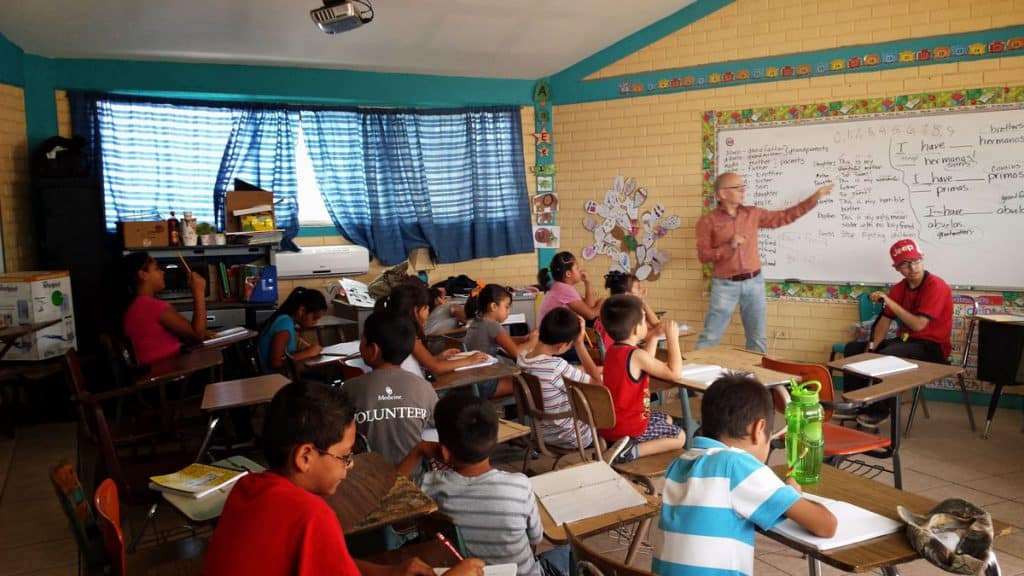
Hubert Lee Lowder is a blur of activity as he teaches English to these Palomas students during Summer School 2016.

by Hubert Lee Lowder

Hubert “Lee” Lowder contributed a full month of his summer vacation from teaching elementary students in the U.S. to live and volunteer teach in Palomas. In this essay he describes his experience and what he learned. We are so grateful to have had him with us–a real Border Partner.

As an educator, I always introduce new units of study and with an essential question. In preparation for my four weeks of teaching at Border Partners’ Summer School 2016, I asked an essential question of myself: What can I learn from the students in Palomas that can improve my teaching and my community in Virginia? Too often, heavily resourced schools and high-income, highly educated communities believe they are the incubators of progressive education and community involvement. My experiences in Palomas dispelled that assumption for me.  Resources and wealth alone need creativity, cooperation and empathy in order to ignite change.

The four weeks I spent in Palomas have altered the trajectory of my life. Not only did I adopt a dog rescued in Palomas and fostered in Columbus, but I left Mexico determined that the final chapters of my life will be spent in service to the people of Palomas and the border area.

  • I owe this to the children I met who value education and embrace curiosity.
  • I owe this to the promotoras who welcomed my poor Spanish and me into their homes for dinners and family celebrations.
  • I owe my service to the dogs that ran with me every morning at 5:30 am and paraded me home beneath the toiling of the church bells two hours later.

How Children Learn

My students in Palomas were free to be children. They played hard, rolled, tumbled and teased each other and their teacher. Their lives are their own, unscheduled and free of the constant anxiety that permeates the classrooms of middle-class America. Are there risks in Palomas? Of course. But, the children are not bombarded with an unrelenting onslaught of remote possibilities and “what ifs.” The children are resilient, curious, welcoming and hungry for books, conversation and engagement.
girl with puppet

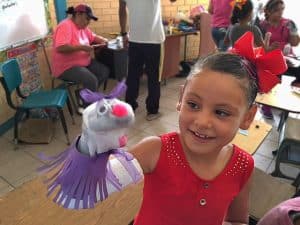
One child delights to display her sock puppet made at summer school 2016.

My students in Palomas moved constantly. A successful English or art class had to adapt to their rhythms and learning style. Forty minutes of sitting still, parroting English would be excruciating for them and doom me as their teacher. Lessons were quick and students immediately applied their knowledge. We acted out stories in English, which later became plays. We created puppets from tube socks, Googly eyes, markers and colored paper. Our first production, Romeo and Juliet in English, starred my right and left hands. Their ill-fated puppy love transcended cultural boundaries and time. It was a huge hit.

What the Teacher Learned

We incorporated English words for family members, pets, farm animals and clothing into our plays. Without any conscience effort the English and art classes merged and became cross curricular. The puppets encouraged children to take risks with English and their imagination. If your accent was off or you used the wrong word, blame it on the puppet.  Afraid of performing? Send the puppet in front of the foot lights.

Since returning to Virginia, I’ve tried to infuse my teaching with the same kinesthetic differentiation that worked so well in Mexico.  A teaching style developed under pressure and desperation in a Mexican border town is now being deployed at one of the best private schools in the Washington, D.C. metropolis. It works. Because, despite border walls, hysteria, the popularity of exclusion and fears of invasion, educators know that children respond to the same basic needs. They want to feel appreciated, wanted and know that they belong.
New dirt bike track open for competitions and fun in Palomas

In the YouTube video (above) enjoy your opportunity to see the dirt track on its first day of use. “Bravo, bravo,” cheers the crowd of onlookers as the kids cautiously navigate the dips and rises between the ridges of the track, doing their best to improve their time while avoiding an embarassing wipe-out.

On two hot days in June, twenty volunteers from Palomas–supported by our staff at their sides–hoisted picks and shovels. Their job: to move a huge pile of gravel around a parcel of donated land. The goal: to make humps and bumps in a large serpentine track so kids could try a new way of riding their bikes. A dirt bike track is an excellent way for kids to get some good exercise while having a whole lot of fun.  

The Palomas town water department donated the use of their equipment. And, they even donated a driver for the two days of dirt bike track construction. The track officially opened for action in July.

The dirt bike track is located on a 200’ x 200’ lot that is surrounded by a four foot plastic fence. Now that it’s finished, the track has a ridge to delineate it. It contains approximately 20 small jumps. The track is only wide enough to accomodate one rider at a time. But it can still host competitions. The competitors in races will be stopwatch-timed so that they’ll be racing the clock.  

The YouTube video at the top of this post gives you the opportunity to peek in to Mexico and watch the track in action on the very first day. Hear the cheers of the crowd and experience the exhileration of competition. All this activity and involvement builds healthy bodies and resilient kids.

US Teacher Devotes One Month to Volunteer Work in Palomas

Hubert (Lee) Lowder

Hubert Lee Lowder, who visited Puerto Palomas last year, is working this coming month as a volunteer with Border Partners.

Hubert (Lee) Lowder is a U.S. teacher who’ll volunteerwith Border Partners while living in Palomas this month. He’s a perfect fit right now, as the promotoras offer their summer school program at Ford Elementary School during his visit. 

He visited Palomas last year and was impressed with what he saw. It prompted him to take hundreds of hours of Spanish lessons and commit to return this month. His perceptive powers touched us. We especially love one passage from his blog that’s a powerful and–accurate–tribute to the people’s ability to use every opportunity and resource to advance their community.

Values education

In this passage he reflects on the values of the elementary school where he teaches–respect, kindness, honesty, trustworthiness and citizenship. He connects those values to his experience last year in Palomas and to what motivates him to return:

The people of Puerto Palomas work extremely hard and possess unlimited ingenuity and faith in the power of community. I’ve seen solar ovens built from discarded wood and glass, beautiful fences made from bed springs, simple inexpensive water filtration systems, lush gardens in the desert and climbing walls for children.

One cannot help but respect and be inspired by the civic pride expressed by the people of Puerto Palomas…

…Why service in Palomas?  We all must start somewhere, next door or in the next country, but service, empathy and humanity give life meaning; they give us purpose and humble us. “

Hubert’s writing a blog so that his upcoming third grade class can follow along and learn with him during his trip. To follow his volunteer experience, read along at: http://lowderinpalomas.blogspot.com/

Reflections on a Decade of Progress in Palomas

computer course graduates

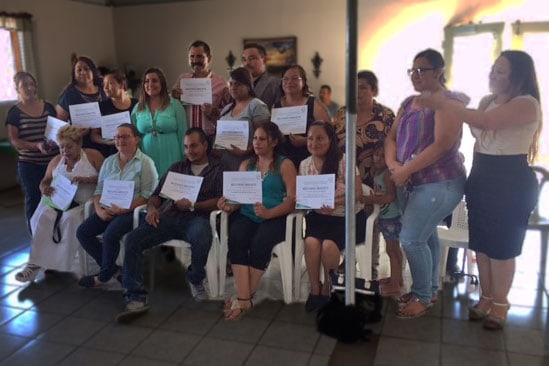
These Palomas adults successfully completed an intensive course in computer skills.

By Peter Edmunds

This week was Graduation Day for 14 students who completed a 12 week computer skills course. This intensive class met for two hours, four days a week.  Half of the class roster was composed of Border Partners staffers who are eager to learn. The event is the most recent in a decade of progress we’ve watched and fostered in Palomas.

Over 60 people came for the festivities and food, including many of the graduates’ friends, families and supporters. Border Partners provided the cake. I sat at the head table for the honored guests and got to congratulate each of the grads.

During the ceremony, while listening attentively to several speeches, I also reflected on Border Partner’s role in making this event happen.

  • Our Education Center allowed the class to happen. Obviously, providing both the place and its computers was a key element.
  • The graduation event was held in the Co-op building. Nearly ten years ago, when the Mayor opened the building to us for the first time, I saw with some dismay the piles of dirt four inches deep in front of the doors—dirt that had blown in over years of disuse.

Border Partners as Change Agent

Last night, during the graduation celebration, I looked around. Border Partners built those walls. We hung those doors. Border Partners wired those outlets. And we built the walls around the toilet (…now that was an improvement!).

Border Partners built the table and chairs where those little kids were eating. We provided many of the kitchen cabinets.

Yes, we’re making progress. We can see it everywhere.

Recipe for a new dirt bike track for Palomas

plan dirt bike trail

Community organizers and volunteers planned and executed the dirt bike course.

work

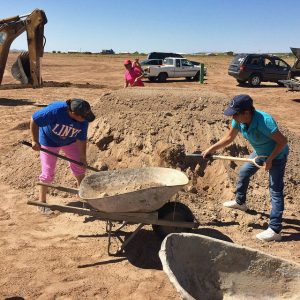
Heavy machinery and hard labor created a dirt bike course for Palomas–all volunteer executed!

by Peter Edmunds

The kids in Palomas had no good place to ride their bikes. So, Border Partners,  equipped with a grant from the Paso del Norte Health Foundation, put things in motion to build them one. Here’s Peter’s story about what it took to make this dream come true:

What does it take to build a dirt bike track on a very hot June day in Palomas?

  • 1 plan for the route the course would take and where to put the hills and jumps.
  • 1 piece of land, donated by a generous landowner.
  • 2 -20 cubic yard loads of dirt
  • 1 tractor-loader, with driver, supplied by the Palomas Water Dept., to move dirt
  • 1 tanker fire truck with three volunteer firemen to wet down the new tracks
  • 15 gallons of Gatorade to avoid dehydration in the 100 degree heat
  • 15 community volunteers, age 9 and up, to move, dig, turn, shape and pack the 40 cubic yards of dirt.
  • 20 lunches purchased from a fundraising event for the high school.
  • 40 pounds of fruit and cookies from Peppers Supermarket in Deming, NM.

Now, hundreds of young teenagers have a place to get good exercise and have fun with their friends.

Many thanks to all the groups and individuals who worked together to make this happen! 

See the big machines and heroic volunteers brave the heat on our online photo album.

Starting Young: School gardens and nutrition classes

kids prepare fresh salad

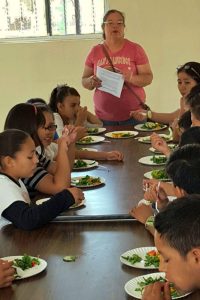
Learning nutrition is “hands-on” (quite literally) as students get involved in preparing nutritious foods.

students eat fresh salad

Students enjoy eating the fresh salads that they prepared as part of nutrition class.

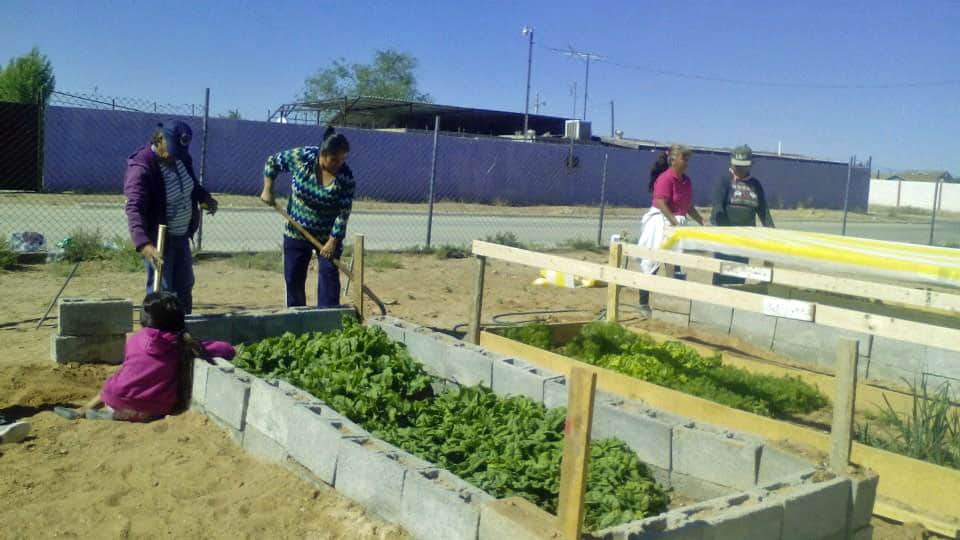
Back in March, Border Partner’s gardeners and volunteer parents began building gardens at two elementary schools in Palomas: Ramon Espinoza and Ignacio Zaragoza. These schools share a facility and grounds but one student body meets there in the morning and a different one convenes there in the afternoon. After planting seeds with the children, each school now has four raised garden beds alongside each other–all growing summer crops in the hot sunshine.

The next step was to ensure the children would eat the vegetables they were growing. So, our gardeners began to get the children involved. They had the kids plant seeds in cups so they could take a plant home. They made a big salad with the kids so they could taste the veggies they were growing. And, they taught them about all the vitamins vegetables have that will make their bodies strong.

In her own words, Juana Flores, tells about the classes she’s teaching:

“The children in one of my classes are from ages 6-7 and in the other ages 9-10. I’m teaching them about the vitamins and minerals that fruits and vegetables have and how to enjoy the flavors of vegetables. Some children are not familiar with the vegetables that we’re growing. These vegetables are chard, spinach, lettuce, cauliflower, broccoli, radishes, tomatoes, cilantro and celery.”

She continues: “The vegetables the children like best are carrots, green chiles, lettuce, spinach, radishes, broccoli, lettuce and cucumber.”

“One day in the class, we prepared a big salad with chard, spinach, lettuce, carrot, green chile and cucumber. The lesson was about vitamins. The funny thing was that the children who said they didn’t like vegetables finished them all and wanted more. They learned that vegetables are very important, so they stay healthy and grow well.”

school gardens

Parent volunteers constructed the covered, raised bed gardens at the elementary schools.

Water Security in the Borderlands: an analysis of Palomas and Columbus

by Emilie Schur

Emilie Schur

Emilie Schur

I am a Master’s student in the School of Geography and Development at the University of Arizona. For my thesis, I am conducting a comparative study of water security in Palomas and Columbus during the months of June and July. From a human development perspective, water security is defined as having adequate, reliable and affordable water for a healthy life (Cook & Bakker 2012). This research is trying to uncover:

  • What causes household water insecurity in colonia communities, and
  • how can access to clean and reliable water be improved?

I chose Palomas and Columbus because they are interconnected by their climate and the transboundary Mimbres Basin aquifer, which is their primary water source. The communities are segregated by the U.S.-Mexico border and country-specific laws and policies that control who has water and who doesn’t. On a broader scale, the U.S.-Mexico border is highly vulnerable to water stress associated with a dry and variable climate, demographic and economic growth, and asymmetrical development in the trans-border region (Wilder et al. 2013). 1.7 million people live in communities—colonias—that are not connected to municipal water and sanitation infrastructure and experience chronic water stress (Donelson & Esparza 2010).

survey

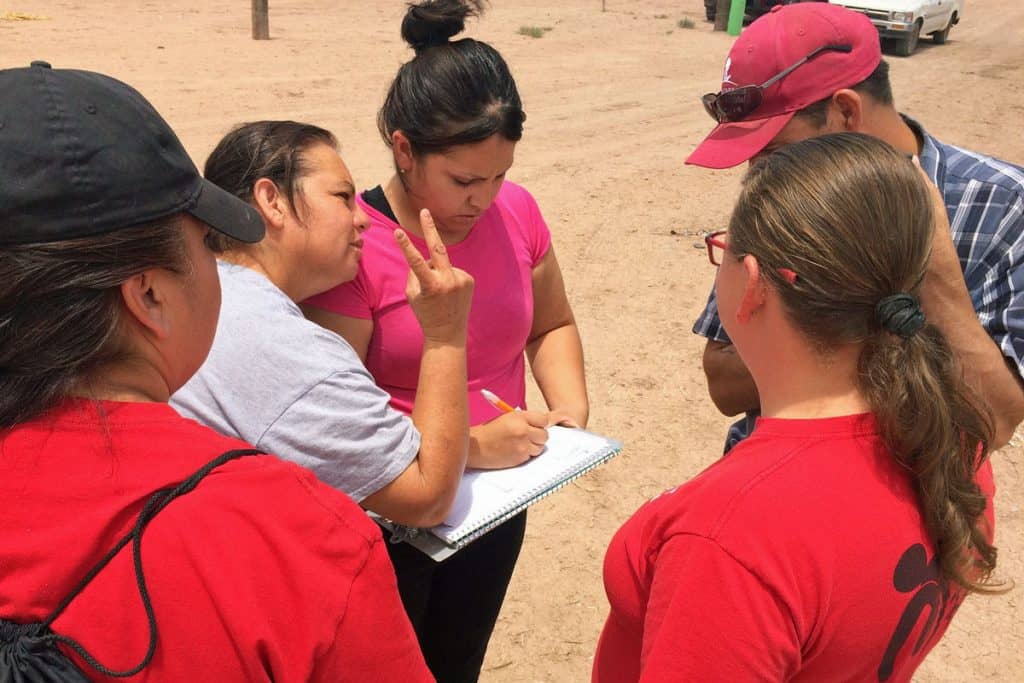
Emily Schur’s research led her to speak with many varied residents of Palomas.

Over the past three weeks, I lived in Palomas and collaborated with Border Partners and their network of community health workers to conduct a household water survey. Palomas is a village of climatic and economic extremes. Scorching summer temperatures crack and blister the earth, wind storms scour unpaved roads and dry arroyos, heavy rainfalls coalesce into muddy floods, and winter freezes crack household water pipes. Pick any street in Palomas and you will find freshly painted mansions guarded by German shepherds juxtaposing dilapidated concrete rectangles with sagging fences filled with trash. Almost half of both types of houses are abandoned. Access to water in this community is controlled by both social and environmental factors.

Next month, I will shift my focus to Columbus and continue my investigations on water access. By the end of the summer, I hope to have gathered diverse perspectives—from households to decision makers—on the status of water on the border. This multi-scalar investigation will hopefully illuminate gaps between water users and water providers and foster a bi-national dialog on water security. This is particularly important as no formal groundwater laws exist between Mexico and the United States (Sanchez et al. 2016), and solutions must be found locally through partnerships with organizations like Border Partners.

borderlands research

Emily’s borderlands research reflects her values and her desire for a better future for all.

Cook, Christina, and Karen Bakker. “Water security: Debating an emerging paradigm.” Global Environmental Change 22, no. 1 (2012): 94-102.

Donelson, Angela J., 1971, and Adrian X. Esparza 1957. 2010. The colonias reader: Economy, housing, and public health in U.S.-mexico border colonias. Tucson: University of Arizona Press.

Sanchez, Rosario, Victoria Lopez, and Gabriel Eckstein. 2016. Identifying and characterizing transboundary aquifers along the Mexico–US border: An initial assessment. Journal of Hydrology 535: 101-19.

Wilder, Margaret, Gregg Garfin, Paul Ganster, Hallie Eakin, Patricia Romero-Lankao, Francisco Lara-Valencia, Alfonso A. Cortez-Lara et al. “Climate change and US-Mexico border communities.” In Assessment of Climate Change in the Southwest United States, pp. 340-384. Island Press/Center for Resource Economics, 2013.

Promotora activity improves Palomas public health

bicycle rodeo

Palomas youth jumped at the challenge of completing a bicycle rodeo course organized by the promotoras.

Our Palomas promotoras (health promoters) are working almost nonstop with activities designed to improve various aspects of public health. Their enthusiasm runs high, and the town responds enthusiastically to a slate of activities that improve the quality of life. Here’s a snapshot look at some of their recent accomplishments:

Spring Health Fair

food at fair

Folks devoured the healthy burritos prepared by the promotoras.

Our new Sports Center site held the promotoras Spring Health Fair event on April 14. The event included healthy food, activities and fun.

Promotoras distributed their healthy burritos, along with popcorn and fruit–with ingredients provided by the COBINA/Binational Health Commission).

The 250 attendees received, free of any charges:

  • flu shots for adults and
  • vaccinations for children,
  • rabies vaccine for dogs and even
  • personal haircuts.

The local gardeners also participated in the fair, distributing tomato seedlings and lots of vegetable seeds to attendees. Soccer and volleyball games during the event provided healthy activity for adults and children.

Bicycle Rodeo and Family Ride

Gran Bicicleteada

Flier advertises the first spring family bike ride.

On April 17, the promotoras organized their first Bike Rodeo for local kids. The event gave our youth a chance to ride their bikes over a dirt course with bumps, twists and jumps–even a water hazard! Not only does this provide healthy exercise, the event also promotes positive community involvement and positive interactions with local adults.

On April 21, promotoras slated their first family bicycle ride of the season. The public was invited to meet at Ford School at 6 PM to launch another spring fun ride. This family-friendly event gets the community together for active, healthy fun. Many participants use bicycles that Border Partners supporters have donated for the town’s use.

Nutrition Classes & More

Bean distribution

Bean distribution

Promotoras also prepared and conducted six nutrition classes each month this year as part of the HEAL grant we received from the Paso Del Norte Health Foundation. They offer a continuing class for 40 women who attend one session each month.  The course started in January with classes on the importance of eating plenty of fruits and vegetables. February’s focus was healthy grains. March lessons considered the value of dairy products, and April’s classes took on the necessity of protein.

Thanks to a donation of a 2,000 pound bag of dried pinto beans from family-owned Diaz Farms in Deming, NM,  the promotoras were able to deliver 20 pound bags of beans to 85 needy seniors and other families in Palomas. These recipients were grateful for this tremendous supplement to their diets.

In addition to special activities, health promoters provide regular office hours to the residents of Palomas. In a donated storefront space, their office is open from 9AM-12 PM, Monday through Friday. They offer free health checks and information. The promotoras also hold regularly scheduled meetings there to plan their activities, discuss their services and coordinate their programming in Palomas.

Diaz Farms Donates a Ton of Pinto Beans!

foklift raises beans

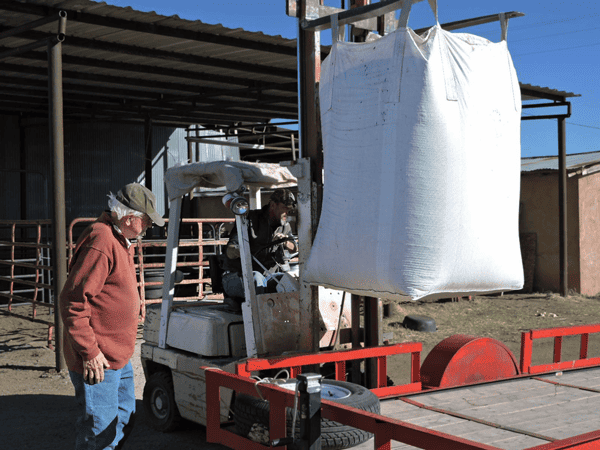
Border Partners’ Peter Edmunds watches the foklift raise a ton of beans, donated to Puerto Palomas.

beans distribution

Promotora Aidé (l) delivers beans donated by Diaz Farms to the home of a home bound senior in Palomas.

On February 23, Peter Edmunds borrowed a utility trailer to pick up 2,000 pounds of pinto beans donated by Diaz Farms in Deming, NM. As you can see in the photo (above), the huge bag had to be loaded with a fork lift.  That’s a lot of beans!

Peter drove the beans to Palomas the next day.  Since the Mexican border guards had advance notice, the procedure to cross them was relatively uncomplicated. A crew of five public works employees helped distribute the beans into 40 fifty-pound bags.

Our Palomas team then distributed portions to three elementary schools, a secondary school and the special education school. We also gave bags of beans to the Comedor, a free government lunch program that primarily feeds low income seniors. The health promotoras delivered smaller bags to homebound seniors.

The gift of pinto beans is an especially appreciated gift in Mexico. They’re a very nutritious food, and everyone loves them! This large and generous donation is helping to feed many needy children and families.

Diaz Farms

Ruben Diaz established Diaz Farms in Deming 50 years ago. But, it is now a family business operated by three his sons, Carlos, Eddie and Sam along with his son-in-law, Art and all of their families. Like many family operations, the business started small. Over the years, Diaz Farms has grown to be a national supplier of New Mexico chile and onions.

Border Partners is grateful for the Diaz family’s generosity!  ¡Muchisimas gracias, Amigos!

To view photos of processing and distributing this pinto bean donation, visit our Flickr album. 

Health promotoras educate Palomas residents about nutrition

nutrition class

Nutrition classes offer participants meals that highlight nutrition basics. This class ends with a healthy meal that participants make and share.

For several years, the gardeners and health promotoras in Palomas saw a need to offer nutrition classes to educate residents in Palomas. Understanding why it’s important to eat certain foods provides reason and motivation to eat them. This educational component became even more important as the gardens in Palomas flourished. We noticed that people didn’t always know how to use the new foods they had available.

Now a grant from the Paso del Norte Health Foundation has made it possible for our health promotoras to offer nutrition classes for 40 families this year. They use a curriculum called  Eating Smart Being Active developed by faculty in the Extension Divisions at Colorado State University at Fort Collins and the University of California, Davis.  The curriculum includes eight lessons, seven of which the promotoras use. (One lesson, developed specifically for people who shop in regular supermarkets with sales, doesn’t apply to our situation.)

The curriculum provides a teacher’s handbook in Spanish and participant handouts.  Our six promotoras have divided the lessons among themselves. Teams of two each teach two lessons.

esba logoCurriculum topics include lessons centered on:

  • eating more fruits and vegetables, whole grains, and dairy,
  • the importance of choosing lean protein, and
  • limiting sugar and fat in the diet.

Each lesson includes an exercise break and teaches people about the importance of getting regular exercise.  Students also get a chance to taste different foods and in some lessons to make a healthy dish.

The curriculum is designed to encourage student participation with the hope that will give people ideas about how to incorporate the changes into their lives. When classes are interactive and directly relevant, it makes the learning practical.

In addition to offering the Eating Smart Being Active curriculum, the promotoras teach many other classes on health topics. Besides offering other nutrition classes, they offer instruction on other topics, covering subjects ranging from self-esteem and stress management to family planning, personal hygiene, and accident prevention. Promotoras implement this curriculum, developed by the Mexican government, in conjunction with the government health clinic in Palomas. Low income families who receive a bimonthly food allotment are required to complete the classes in that series.