Palomas Health Fair combined action, education and enjoyment

by Polly Edmunds

glucose screening

Promotoras offered free screenings for blood glucose levels at the free Health Fair in Palomas. The boy in the foreground is examining a box of free children’s vitamins that was distributed at the event.

The Promotoras and Centro Salud staff deserve hearty congratulations for conducting a wonderful health fair last Saturday, April 13 in the Central Park in Palomas.  Both groups together planned an ambitious list of activities. Thanks to their hard work, everything ran smoothly.  A big thank you goes to COBINA–the Binational Health Council–for providing the funding that made it possible!

healthy burritos

People loved the free, healthy burritos that the Promotoras served.

The Promotoras checked blood pressure and glucose levels. They also served free burritos on whole wheat tortillas with vegies from their gardens plus donated ones they received from stores in town. The grocery stores also donated fresh fruit and bottled water so that was available, as well.

Thanks to Healthy Start in Deming, they were able give some prizes to children for participating, as well as pamphlets on health topics to their parents.  Books are Gems, an El Paso nonprofit organization, also donated some children’s books to give away.

Dr. Carrasco and her assistant administered free rabies shots for many local dogs. They also brought children’s vitamins, Border Binational Health Week caps, and lots of literature to give away.

zumba session

Marisol Guillen offered free zumba lessons to enthusiastic participants.

Zumba sessions through the day and a jumping cage set up for the kids were very popular!

In addition, the Promotoras asked students from the beauty school in town to give free haircuts.  Many people who had not been able to have a haircut for a long time were very happy to receive this service.

This health fair was very successful and I hope it will prove to be the first of many joint projects for Centro Salud and the Promotoras.

Click this link to view a survey of photos from the day at our Flickr site. You will see what I mean!

COBINA, the health fair event sponsor, is the Columbus, Luna County, Palomas regional health council. We appreciate their support so much.

Palomas principal appreciates help that makes a concrete difference

school food program

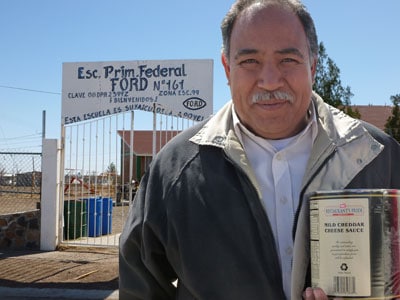
Ford Elementary School principal Angel Garibay displays canned food Border Partners deliveredi

We at Border Partners prefer to partner with existing institutions in order to provide material assistance. Institutions already in place are more familiar with the needs of the people and have also determined the best way to address those needs. One partner institution with whom we’ve developed a warm relationship is the Ford Elementary School in Palomas.

When we were making a short pre-Christmas visit to Ford, Angel Garibay, the Ford principal, seemed delighted to have the chance to thank Border Partners and its supporters for the concrete support his school has received from them. The Principal in fact immediately launched into a beautiful and impromptu statement of appreciation when the microphone was passed to him.

We present to you his statement –translated whole and entire. It is you who make this good work possible through your donations. We want you to know how much it is appreciated.


I appreciate the work that Border Partners has done, especially in education. Their support of us [at Ford School] has been very good.

They have especially helped us in two areas.

First: in the area of computer technology, their “computer team” helped us acquire the equipment. Now the children have a computer teacher, and they also have the machines so that they can work.

The other area—one that’s also very important–is that every month Border Partners supports us so that we can provide food for the students. That means that they bring us eggs, potatoes, fruit, cheese, a variety of canned products—and all of this is for the good  of the children.

The children are eating breakfast here between 7:30 and 8 AM and they eat another meal here at school between 1:30-2 PM. This would not be possible without the assistance you’ve given us.

At this point in the end of the year, hope that God will bless every single person who has helped us through these projects. We also hope that 2013 is filled with fruitfulness for you all.

Update:

Ford students at garden

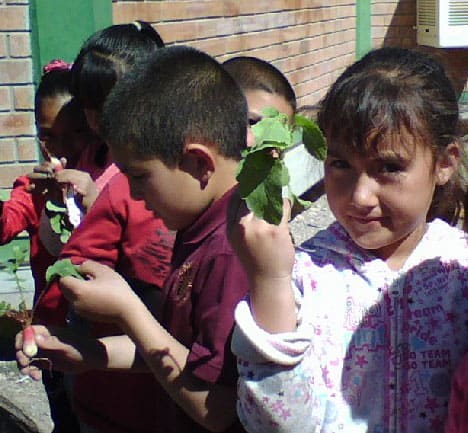
Ford Students are successful gardeners.

Now that 2013 is underway, we’ve begun and accomplished two more important projects at Ford. In addition to the new school garden plots that are already producing (see photo, right) we also installed a solar cooker. The school food program will be able to use the cooker, utilizing free sunshine rather than the expensive utilities of gas and electricity, to provide warm food for the children.

You help allows us to augment the important work of the Ford educators, enriching the lives of the young students. Thanks for your support!

Students Create a Ford School Garden

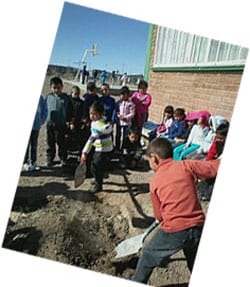
garden diggingThe elementary school students at Ford School in Palomas are doing-it-themselves. They’re creating a school garden. In fact, they’re building several raised bed plots.

The plots will teach life-learning lessons about gardening, food and nutrition. Eventually, teachers will base curriculum lessons on the gardens–particularly in math and science. Best of all, the students will proudly eat the food they’ve raised themselves at school lunches.

In this photo sequence you’ll see the students building the raised bed frames for the garden plots and preparing the soil. Their intense interest and eagerness to participate in the process can’t be faked–it’s “the real McCoy!”

Our garden coordinators are working closely with the Ford School staff to direct and teach the children. But, the digging, the hauling, the watering, the planting–actually, in every aspect–the students are doing the work themselves.

See this process for yourself on our Flickr set: Ford School Garden! Thank you so much for making the good work possible with your support! [Click on the thumbnails individually to see the full-sized photo for better viewing.]

Watering101_0831101_0832101_0833101_0835101_0834
101_0836101_0837101_0838101_0839101_0840101_0841
101_0842101_0843101_0844101_0845101_0846101_0847
101_0848101_0849101_0851101_0852101_0854101_0856

Ford School Garden, a set on Flickr.

Promotora group trained to combat disease, promote wellness in Palomas

promotoras focus on Mexico's health crisis

Health promoters, called Promotoras, focus on addressing Mexico’s health crisis during recent training in Palomas

Hypertension and diabetes are epidemic in Mexico. Seventeen million people ages 20-69 are diagnosed with hypertension.  Fourteen million adults have high cholesterol or triglycerides and six million more have diabetes 2. All of these diseases are related to being overweight! All of them can be prevented by making different personal choices.

These stunning facts opened the second training sponsored by Border Partners of a group of Promotoras (Health Educators) on August 27-29 in Palomas. Mexico’s health status underlines the importance of equipping citizens to meet epidemic needs. Three days of training last month launched these new trainees with:

  • a basic understanding of hypertension and diabetes,
  • skills empowering the new promotoras to assess disease risk factors, and
  • updated recommendations from professionals on disease prevention and control.

The trainees were active learners, using a “hands-on” approach and valuing their opportunity to learn the use of genuine medical instruments to measure blood pressure and blood sugar.

promotora measures blood sugar

Mayela takes Josefina’s glucose during the promotora training, using an authentic medical glucometer.

The promotoras also learned the Five Steps Program, an effort in Mexico to raise public awareness of the steps individuals can take to improve their own health and avoid hypertension and diabetes. The Five Steps/Cinco Pasos are:

  1. Move!  Get more exercise:  30 minutes per day for adults, 60 minutes per day for children.
  2. Drink water!  5-10 glasses each day. Dehydration plays a big part in the development of chronic disease.
  3. Eat vegetables and fruits!
  4. Maintain good emotional health!
  5. Share information with others!

The promotoras are now equipped with several strategies for lowering the numbers of people with chronic health problems in their community. The training emphasized utilizing education campaigns, screening events, exercise classes, and support groups as grassroots efforts that will address these health needs.

The promotora group received their initial training in June. Border Partners is pleased to be part of the process of advancing health through community action.

Promotora training group and trainers, August 2012

Promotora training group and trainers, August 2012

Promotora training in Palomas: Another step toward creating an engaged community [slideshow]

Promotora (health promoter) training sessions occurred in Pto. Palomas, Chihuahua, MX on June 6-8.  The trainer team of medical experts traveled to Palomas to equip a group of 12 local trainees to engage their community to work together at the grassroots level to promote a healthy environment and raise community health standards .

The six session program began on the first day with an introduction to the working of health promoters and a consideration of what factors determine the health of a community.  After lunch, participants learned about the importance of good nutrition and physical activity.  The trainers led a fun session of aerobic exercise.

The following morning began with a group exercise followed by a presentation on the elements of good personal hygiene and basic sanitation for the community.  Trainees formed three team, each of which prepared a presentation about a different element of hygiene:  personal, home or community hygiene.  After time to prepare a poster, each group presented their ideas to the group.  At the end of the morning, the trainers presented information about the booklets that are used in Mexico to track an individual’s health information.

That afternoon a presentation about preventing addictions to tobacco, alcohol and drugs was followed by a “Jeopardy” type game using questions about drugs, alcohol and tobacco use and addiction.

The final training day covered the prevention of traffic accidents and considered mental health with a good individual exercise looking over one’s life for the good and the bad events that had been influential.  The final session was on responsible sexuality.  After a presentation of information, three groups were challenged to develop a poster and presentation about a related topic.

The trainees valued their experience and look forward to addressing issues that negatively affect Palomas health. The issue of debris and the prompt removal of dead animals in the town may be a potential first concerted effort for the new promotoras.

The principal promotora trainer was Dra. Elisa Aguilar Jimenez, Coordinadora Oficina Chihuahua from Comision de Salud Fronteriza  Mx-EU. She was assisted by Enf. Sigifredo Pena Flores, Coordinator of Promotion of Health, State of Chihuahua, MX; Lic. Estella Aizpuru Gardea, Coordinator of School and Health Programs, State of Chihuahua, MX; and Lic. Liliana G.  Trejo Rodríguez, Adjunct Coordinator of School and Health Programs, State of Chihuahua, MX.


Top 4 Needs in Puerto Palomas, Chihuahua, Mexico

A Special Report by Polly Edmunds, Border Partners co-founder

Itʼs always difficult to know where to start when I am asked what the top needs are in Palomas. I wish I could take you on a tour of this Mexican border town, and you would see for yourself as we drive along the dusty, rutted streets: the empty factories, run-down housing, poorly equipped schools and parks.

But I think you would also be impressed with the calibre of people you would meet. Despite difficult living conditions and generally low levels of education, so many people in Pto. Palomas are energetic and hopeful for their communityʼs future.

Need #1 More income

After working closely with people living in the community for four years, I can say with confidence that their most important need is for more income. By some estimates, unemployment in Pto. Palomas is at 80%, but most people do find some way to make a little money. They have garage sales, wash cars for tourists or sell cookies to a local grocery. Right now there is work in the fields
paying about $10 for a nine hour day. Border Partners is always looking for opportunities for people to earn money. This is our greatest challenge.
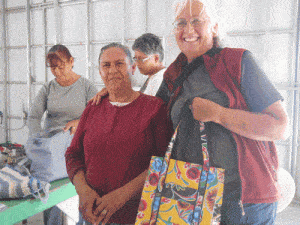
Palomas Oilcloth Designs: Creater and customer meet

Palomas Oilcloth Designs: Creator and customer meet

Accomplishments and Hopes

  • We’ve helped seven women start their own cooperative business, making products out of Mexican oilcloth. They now run this business themselves, needing assistance only for sales in the USA.
  • Border Partners employs three Mexican citizens who work in their community promoting our programs year round. We hire several more for special projects.

Need #2 Programs to improve health

On our tour, the second need would not be as visible. Because of chronic low income and lack of good, affordable fruits and vegetables in the stores, there are many health problems associated with poor nutrition: high blood pressure, diabetes and respiratory illness. Many people are overweight. The parks do not have good play equipment nor are there programs for children to get good outdoor
exercise.

In addition, there is only one public clinic in this community of about 5,000 and no private doctors. The closest hospital is in Deming, NM, and most people cannot cross the U.S. border to access it. The closest hospital in Mexico is 1.5 hours away.

home garden

Introducing cold frame gardens to Palomas provides improved nutrition, even during the winter months.

Accomplishments and Hopes

  • Border Partners has helped 35 families start year-round home gardens so they can grow their own, organic vegetables for their families. Our promoters offer free materials, seeds and technical assistance. We would like to expand this program and eventually start a farmers market.
  • Border Partners sponsors three free aerobics classes every week.  We hope to soon build adult exercise stations in one of the municipal parks.
  • Border Partners has made improvements at two city parks, adding playground equipment, volleyball courts, basketball hoops.  We hope to build a dirt bike track and climbing wall which would provide more recreation for teens. There is very little for them to do in town.
  • Border Partners provides about $150 worth of canned fruits and vegetables,cheese and eggs to each of three elementary schools each month. This supplements the dried foods they get from the government and improves the quality of nutrition the children receive at school.
  • In June, 2012, we sponsored a training for community health educators. There is a great need for health education for all ages. The teen pregnancy rate is high. Child abuse rate is higher in Pto. Palomas than in other parts of Mexico.

Need #3 Education

Many people in the community have not completed more than the 6th grade. Many families can’t afford the costs of education.

Accomplishments and Hopes

  • Border Partners has upgraded the computers at the public library so that now they have 12 computers connected to the internet. Some of the main users are high school students because the Prepatoria (high school) in Pto. Palomas does not have internet. We hope to build an community education classroom with state of the art equipment so it can offer distance learning college classes as well as basic literacy, math, computer skills. 
  • In August 2012, Border Partners will set up a computer lab for each of the three elementary schools. They will be able to use learning software provided by the Mexican government. We would like to add more computers to each lab. For now, we only have six for each school.

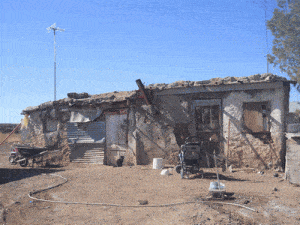
Need #4 Better Housing
Palomas dwelling

Many family homes in Palomas are substandard.

Many of the homes are in poor condition, unfinished and/or very small. Most are constructed of cement blocks which provide poor insulation. Thus, homes are hot in the summer and cold in the winter.

Accomplishments and Hopes

  • Border Partners collects used and donated building materials and helps people fix their homes.
  • We are supporting a group of women who want to repair their homes by teaching them to make papercrete blocks (made of cement and recycled paper which makes them highly insulating and lighter than pure cement blocks). The women can use these blocks to repair and expand their homes as well as to sell so that they have money to buy other construction materials they need to upgrade their family’s homes.

The needs are clear to us. The people of Palomas are ready to work toward a better future. We invite you to join with us as we build a better U.S.-Mexico border community together.

“People say, ‘What good can one person do? What is the sense of our small effort?’ They cannot see that we must lay one brick at a time. We can be responsible only for the one action of the present moment.”  – Dorothy Day

Promotora training opens another avenue to improve Palomas

Twelve Palomas women completed a training for Health Educators (Promotoras) in Palomas on June 6-8. Border Partners and the Columbus, Luna County, Palomas Binational Health Council (COBINA) co-sponsored the event, funded also by the Ben Archer Health Center.  The Office of Border Health in Juarez, led by Dr. Elisa Aguilar, conducted the training.

The concept of “health” was presented in a very broad-based context. Training considered the multitude of factors in a community that promote wellness for its members. In addition to attention to health problems and diseases, these factors might also include, for instance, the presence of health services, sanitation, environmental factors, such as the presence of dust in the air, and the community’s level of health-knowledge and health-awareness.

Border Partners co-founder Polly Edmunds, who also participated in the three-day promotora training, was excited by the evident commitment of the twelve Palomas women trainees who, “despite sweltering heat, persevered through three full days of training.” Polly also observed that the women themselves are “excited about the possibilities for change for their community.”

Palomas promotora training group

Palomas promotora training group, June 2012

Trainers encouraged the participants to design and present community workshops that:

  • empower the townspeople to develop the capacity to express their needs;
  • identify and define their problems;
  • design strategies of participation and
  • organize effectively to address the issues that affect the community’s health.

Workshops that the newly-trained promotoras will design will help townspeople reflect on health risks that confront their state and community. Workshop participants will identify health issues that affect their community and learn strategies to counteract those health risks.

Health promoters can expose problems in a community and ask the proper authority to make changes.

Newly-trained promotora Chayo Covarrobias declared that her dream was to have a “healthy and clean community,” a sentiment to which most of group agreed.  Benita Saenz added that she would like to see the day “when people drive through Palomas and want to visit because it is a pleasant place.”  Others expressed that they would like a community characterized by greater employment opportunities and “less illness.”

“The trainers stressed the idea that change starts with yourself. It’s easy to blame everyone else. People need to organize,” concluded Polly Edmunds.

Desert Exposure spotlights Border Partners


Desert Exposure masthead

Desert Exposure masthead

Desert Exposure, a free monthly magazine in tabloid format, is featuring this month Border Partners’ work and activities in Palomas. It is running an extensive article by Marjorie Lilly, entitled “Putting Heads Together,” as one of its major news stories for June 2012.

Marjory Lilly traveled to Palomas twice as she researched her material for the article. She visited gardens, a gardener’s meeting, our woodworking shop and a Palomas Oilcloth Designs business meeting. She also individually interviewed Polly and Peter Edmunds, Border Partners founders, and Joel Carreon, a member of the Board of Directors.

The article demonstrates the needs in Palomas and showcase some of the ways Border Partners is responding. A few highlights from the article:

  • Juana Lozoya, our Palomas garden promoter, shared her belief that every garden member family has lacked food at some point in the past year or so.
  • The gardening group membership has grown from just 15 last winter to 40 members currently.
  • Border Partners is introducing “papercrete” — bricks made from paper, sand, cement and water–in Palomas constructions due to its phenomenal insulating qualities.
  • The women of Palomas Oilcloth Designs earned an average of $75 a week in 2011, an increase from just $45 in 2010. “This group is really in business now,” states the article.
  • Border Partners is the only international organization currently in Palomas that is doing “development projects.” Other groups primarily distribute supplies and provide services.
Marjorie Lily

Marjorie Lilly (photo credit: Desert Exposure)

Desert Exposure has served readers throughout Southwest New Mexico since 1996. It’s been called “the New Yorker of New Mexico” for its unique mix of investigative reporting, colorful columnists, in-depth feature journalism, interviews, offbeat stories, arts and events information and humor.

Desert Exposure reported in May 2009 on our worker-owned women’s cooperative business when it was but a fledgling group [c.f. “Viva La Cooperativa”]. Palomas Oilcloth Designs, now standing almost completely independent of Border Partners, receives important attention in the article. [See also “Some News from Palomas Oilcloth Designs” for recent updates.]

We genuinely appreciate Marjorie Lilly’s time and attention to detail as she reported on the community development projects Border Partners has initiated and/or supported. Desert Exposure’s distribution will broaden regional awareness of both the needs in Palomas and a number of the ways we at Border Partners are “putting heads together” on the U.S.-Mexico border to address those needs.


Meet Juana Flores, our newest Palomas promoter!

Juana Flores

Juana Flores, our newest promoter in Palomas, at her home garden.

Juana Flores, our newest Palomas promoter, came on-board this spring to coordinate projects funded by our grant from the Border Environment Cooperation Commission (BECC). She heads the crew that is installing greywater reuse systems in the homes of Palomas gardeners. These systems divert washing machine water to the gardens to irrigate the home crops.

Juana and her crew have already installed 21 such systems, after beginning production in April. These yield significant improvements by:

  • boosting plant growth in our harsh desert environment
  • diverting water that would normally be lost to the sewage system
  • preventing increased utility bills by diminishing the fresh water needed for irrigation
  • conserving the precious natural resource of water–particularly important during this time of severe drought.

These photos illustrate that the water reuse systems, coupled with our compost soil augmentation system, are producing remarkable results:

Juana Flores in garden: April 18, 2012

Juana Flores in garden: April 18, 2012

Juana Flores garden: May 11, 2012

Juana Flores garden: May 11, 2012

In a few weeks, the plant growth is significant. The graywater reuse collection system is visible in the May 11 photo (above): note the blue barrel next to the house, toward the rear of the garden. The technology is not complex, so the cost is reasonable.

Border Partners assists air quality assessment of Palomas, Mexico border region

installation of air quality monitors

Edgar Mendoza installs an air quality monitor in Palomas.

Our U.S.-Mexico border region of Chihuahua-New Mexico is now bejeweled with six new air quality monitors.  Border Partners is currently participating in a study of border air quality conducted by New Mexico State University, funded through a research grant administrated by NMSU Professor David DuBois.

The devices are located on electric poles 10 feet above the ground and will remain in Palomas for the duration of the study. The monitors’ automatic timer collects dust and other air pollutants at 24 hour intervals. Those filters are then collected and replaced every other day, a total of 16 times. Border Partners will service the monitors: collecting and replacing the filters, then delivering them to the researchers.

Palomas residents Marisol Guillen (a Border Partners promoter) and Edgar Mendoza assisted with the installation of the air quality monitors and will continue to help with the project’s data collection. Air quality is also being monitored on the U.S. side of the borderline in Columbus, NM.

The information that this study yields will help researchers assess the air quality of the border. Because border crossing traffic is funneled into our area, more air particulates could be concentrated here, too. Several of the Palomas monitors are located in the stockyards area to assess the impact of livestock manure on air quality.

collecting scientific data on air quality

Marisol Guillen dons gloves to collect scientific data on air quality.

The quality of the air we breathe directly affects our health. Participating in this project will help us better understand our border’s environment and the special needs we may have as a result of our area’s international role.