New Community Sports Center puts focus on sustainability

Construction of the new Community Sports Center in Palomas models Border Partners values of people-centered development and sustainability.

Construction of the new Community Sports Center in Palomas models Border Partners values of people-centered development and sustainability.

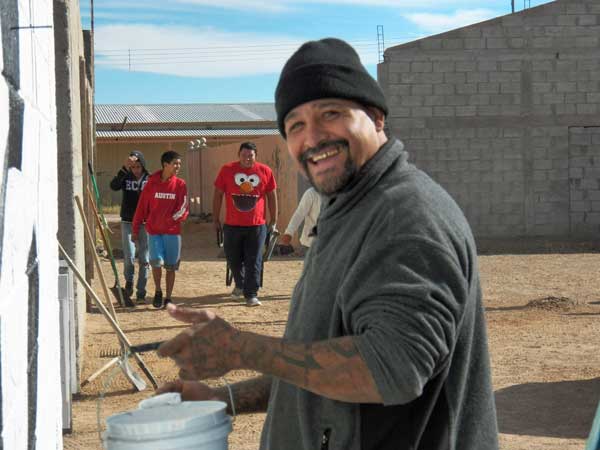
The new Community Sports Center in Palomas–a major Border Partners project to improve life in Palomas–models Border Partner’s value for sustainability and people-centered development. A project that’s been years in process and several months in direct development, the sports center building makes the best possible use of resources that are available in the town to stretch funding dollars and accomplish more. In concept and in implementation, the Community Sports Center reflects Border Partners’ commitment to sustainable and community-centered development.

Building Re-purposing

A building that was built as a factory, but never actually used, had fallen into disrepair and begun collecting debris. When Border Partners approached owner Phillip Skinner with a proposal to re-purpose the building into a community sports center, he generously agreed to allow the building to serve that use.

Basic rehabilitation of the building required months of clean-up and many trips to the landfill for the small crew that began  work. They had to clear the facility and the area that surrounded it of dozens of small trees and also thorny bushes that had grown to up to 5′ in height.

The area was littered with broken glass, plastic bags and garbage. Workers cleared all this before construction of the facility could begin. The project essentially rehabilitated a city block, turning an eyesore and sanitation hazard into a town asset.
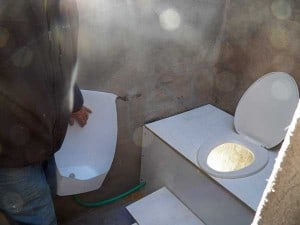
Dry toilet under construction

Dry toilet under construction

Sustainable Sanitation

Promoting sustainable sanitation is a hallmark of Border Partners. We’ve promoted and built dry toilets since our earliest days, installing them in various places in Palomas. Dry toilets offer sanitation at low cost, because they do not require water, connections  to city sewage lines or elaborate septic systems. So, it was natural for Border Partners to augment the sports center with dry toilets for the athletes’ use.


Recycling Available Materials
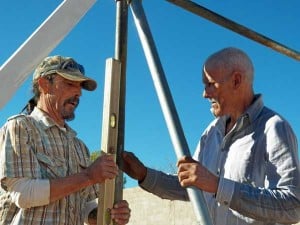
Reused PVC pipe becomes soccer goal

Reused PVC pipe becomes soccer goal


Commercially purchased soccer goals are expensive. To circumvent that cost, Border Partners workers devised the plan to recycle some pipes that remained from a playground climber that formerly occupied a Palomas park. This piping has had several “lives” as we’ve reused it over and over in several recreation configurations. It now stands proudly in cement, ready to signal the traditional soccer victory cry of “Goooooooooooooooal!”
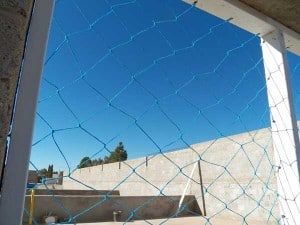
Homemade window protection

Homemade window protection

“People Powered” Construction

Similarly, commercially purchased soccer goals are costly. But with the available “people power” of many willing community workers and volunteers, home-made nets now adorn more than just the soccer goals. Macrame nets also cover the windows of the facility, preventing errant balls from exiting the building and will eventually separate the courts in the facility allowing play of several games concurrently.

Community Sports Teaches Sustainability

A community project can stretch funding dollars and can also serve as a model for a community like Palomas that has few available resources. This Community Sports Center has been a boost to the town by providing a major recreational asset. That in itself would have been laudable. But, even better from our point of view, the project promotes values that we hold dear: sustainable technologies and people-centered  development. For that, we are pleased and grateful.

Master Gardener Visit Yields Benefits that Cross the Border

Jackye Meinecke (L) chats with the Border Partners team Juan Rascon, Peter Edmunds, and Juana Flores during her visit to our garden program in Puerto Palomas.

Jackye Meinecke (L) chats with the Border Partners team Juan Rascon, Peter Edmunds, and Juana Flores during her visit to our garden program in Puerto Palomas.

Jackye Meinecke, a master gardener from Las Cruces, NM, responded to our invitation to Puerto Palomas. Her mission on September 21 was to see Border Partners’ garden projects and advise us about our methods. It was a productive visit!

As Jackye arrived that morning, the local gardeners were in the process of moving the locations of garden beds inside the community greenhouse. Immediately, Jackye admired the healthy soil, appreciatively cupping it in her hands and sniffing it. Jackye was able to offer some advice on bed location and design, but she also generously affirmed the gardener team on the good work they were accomplishing.

Noting that would be a difficult to cultivate plants near the building, Jackye advised that we increase rain water collection along the exterior of the building walls. If even weeds don’t grow in any location, she commented, that’s a sign that it will be hard to make any other kind of plant grow in that location.

Jackye also advised us to ensure that tree roots don’t encroach into the nearby community demonstration garden bed. She recommended adding compost around the base of the trees to promote tree health.

Jackye enjoyed samplings of various edible plants we offered her. She seemed to appreciate this opportunity, as some of them are quite uncommon in the U.S.

Jackye then toured many of the home gardens around town. At the various home sites, she offered advice that would promote improved plant production by altering bed design, by using home livestock compost and by rotating garden locations.

While at various home gardens we all enjoyed sampling white pomegranates. Although Jackye had heard of this variety, she had never before tasted it.

Jackye’s visit to Puerto Palomas concluded with lunch with members of the Border Partners team. It was a beneficial day of real cross-border partnership. View more images from the day on our Flickr album.

Puerto Palomas Health Promoters focus on children with special needs

child development classes

Mothers receive training on how best to support the development of their children with special needs at child development classes in Puerto Palomas. Our health promoters augment this effort and participate in offering the classes.

The health promoter [promotora] group of seven women works closely with the staff of the town’s Health Center [Centro de Salud] to extend health education and health enhancing activities into the daily lives of the townspeople. Border Partners, which provides direct support and resources and finds training opportunities for these women, is pleased with their recent new focus on assisting families of children with developmental disabilities and special needs.

As part of this effort, the promotoras visit homes of families identified or considered likely to benefit from these supportive services. The promoters conduct a health survey, appearing at the doors of the families and asking to visit the parent(s) to conduct a short interview. They

Dra. Lina Carrasco

Doctor Lina Carrasco (top) of the local clinic in Puerto Palomas demonstrates to moms how best to promote child development.

inquire as to the needs of the household, asking, for instance:

  • Do any of the children have special needs?
  • Are the children moving, walking, speaking, responding appropriately for their age?
  • Would the household benefit from receiving a food supplement basket?

Questions are suggested by the Mexican government and responses recorded for the town clinic.

As a result of the survey, families have already experienced benefits. Infants and children with motor disabilities, for instance, are receiving direct assistance at classes that teach parents how to stimulate greater development. Gricelda Loya, local leader of the promotoras, reports that even one class session can produce rather dramatic improvements in infants. Early identification and early intervention can promote lasting improvement.

Gricelda trained in Casas Grandes, Mexico to learn the stimulation exercises that they are teaching the mothers.  She has subsequently taught some of the other health promoters who have added this project to their regular activities which include:

  • regular hours at their Palomas office during which they can provide health advice, check blood pressure and glucose levels and make referrals to the Centro de Salud;
  • monthly visits to the town meal site to check blood pressure and glucose;
  • twice yearly health fairs;
  • assisting clinic staff with registering families for services.

This weekend they will administer flu and tetanus vaccines at the Christmas event in town.

Photos by Gricelda Loya, leader of Puerto Palomas health promoters

BONUS: Photos of moms, children and healthy learning on our Flickr Album by Gricelda Loya

Water filtration project provides safe water to Puerto Palomas

water filtration workshop

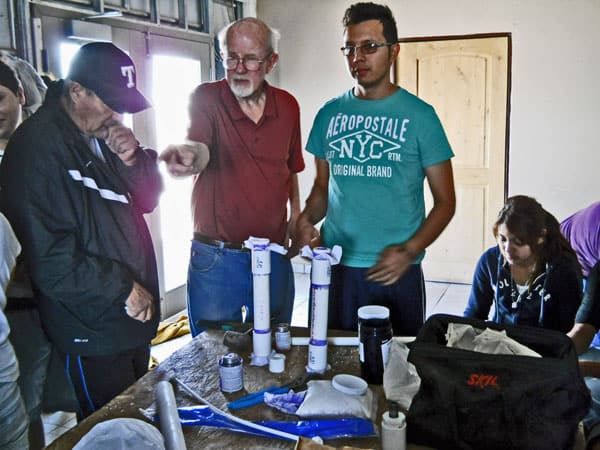
Border Partners founder, Peter Edmunds (center) helped Juan Carlos Huerta (right) of Puerto Palomas lead a workshop to produce water filters for testing.

Public drinking water in Puerto Palomas contains naturally occurring heavy metals that are detrimental to long term health, particularly for children. Levels of arsenic surpass 20 times safe standards; there’s seven times too much fluoride.

The town provides two public water filters but residents must pay 1 peso per gallon for the safe water. Regularly transporting large jugs of water to one’s home is time-consuming and heavy–as a five gallon jug weighs over forty pounds.  And the amount of water needed in a school for the drinking needs of students, staff and for lunch cooking requirements prohibits use of this safe water.

Erin Ward, the Director of the Southwest Consortium for Environmental Research & Policy and Joshua Gomez, an engineering student from New Mexico State University, contacted us at Border Partners to introduce a public domain design water filter to Palomas. The filter is composed of common plumbing parts and chemicals.

This filter, which can easily be installed in public buildings and in homes, allows access to safe water to all at a low cost.

Making sure it works!!

Border Partners is working with community members to introduce this filter, run tests to make sure that it works well and to find out how long the chemicals will filter to safe  standards. We needed to find a source for the chemicals and to refine the design to keep the cost as low as possible.  In June, 2014, filters were built by high school students and installed in the community demonstration garden, as well as in the three Palomas public schools. In July, water samples were tested and found to meet the standard set.

Peter Edmunds secured interest from the community, arranged for their involvement, transported water for testing and secured donations to fund the project.

News of this advance spread. The Mayor of Ascension, the county seat,  asked for filters to install in 30 schools in the district and partially funded their production.

Currently, the latest model of the filters is installed in the three schools and the garden.  The next step is to have the water tested by a Mexican water testing lab.    After we clear that hurdle, we will be able to install the filters in all 25 of the schools in the district and sell the filters to the public.

Two men from Palomas are developing a business plan to launch a way to sell these water filters in Mexico. If successful, this will contribute to economic development in the town, providing jobs and reliable income.

Summer activities in Palomas enthuse Border Partners intern

by Catie Carter

Catie Carter and water filter project

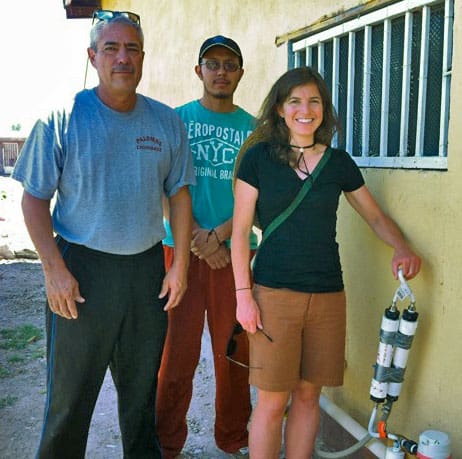
Catie Carter [right], Border Partners summer intern in sustainable technology, displays the important new water filter that Juan Carlos, the high school Chemistry teacher and Joel, the high school Physics teacher,are introducing into the Puerto Palomas community. This water filter will remove toxins of arsenic and fluorides.

Hola! I am Catie Carter, a PhD student in Sustainable Design at the University of  Texas, Austin. I’m volunteering and studying activities here in Puerto Palomas this summer.

I arrived last week and have already met so many lovely people working towards positive change in Palomas. The picture above shows me with Juan Carlos, the high school Chemistry teacher, and Joel, the high school Physics teacher, who are creating a simple and important water filter to distribute through the town, starting with the schools.

This water filter is specifically designed to pull toxic arsenic and fluorides from the water. Right now, the two men are working on a prototype and conducting quality testing. They were excited to show me their work one afternoon.

This project is one of many initiatives that Border Partners supports and that community members and leaders carry out. In my first week here I’ve met many others committed to improving their community:

  • the education center’s neighbor Sam, who now runs a papercrete business;
  • the friendly and fun group of promotoras who promote health, good nutrition and exercise and run the summer school;
  • the enterprising group of women who craft oilcloth bags and aprons for Palomas Oilcloth Designs;
  • the gardeners, working in both a demonstration garden at the center and helping to make home gardening the norm …and even more!

In coming weeks of July, I’ll learn more about the new bio-char projects, solar oven operation, the papercrete manufacturing, solar hot water heaters and other initiatives.

The community has been so welcoming. I’m inspired by everyone’s energy, commitment, and the friendships they have formed.

In the coming years I hope to write a meaningful and helpful dissertation about sustainable design in the Borderlands. My experiences here with Border Partners and the Palomas community will be invaluable in my investigation on change in “the built environment,” the human-made space in which people live, work, and recreate daily.

Life ends, but assistance to programming continues–thanks to supporter’s help

Pat Dingels

Pat Dingels’ positive influence will continue to promote growth and assistance. [Contributed photo]

Our friends on Facebook saw Border Partners’ supporter Pat Dingels’ positive “thumb’s up” frequently. No matter what the status update, we could count on her “liking” our news about Palomas Oilcolth Designs. Her encouragement was unflagging, and she was a good customer of their products, too. When we received word of her death last month, we grieved. But Pat’s support of our programming continues, nevertheless, and in a unique way.

One of our unfulfilled wishes of recent years has been for a golf cart. We can envision so many practical uses for this simple form of transportation in the town of Puerto Palomas, a place where many people don’t own personal cars. When we learned that Pat bequeathed her golf cart to us, we hastened to transport it from it’s storage place in Arizona to its new home, serving residents on the U.S.-Mexico border.

Because this golf cart is electric, it roughly costs only 2 cents per mile to operate. Our truck, in comparison, costs about 20 cents per mile to operate. Although the cart must be recharged after about 80 miles of use, it will still save us money. Moreover, it uses no gas and produces no emissions.

golf cart

Gardening coordinators are eager to use the golf cart to visit home gardens in Palomas.

Our new golf cart will allow Border Partners’ local coordinators to get about town efficiently: be it to visit gardens, get to meetings or assist local residents in need. Since our mission promotes sustainable technology, we plan to equip the cart with solar panels, so it won’t need fossil fuel. Palomas’s bountiful sunshine can power the cart’s trips about town. Then, it will leave no carbon footprint at all!

When people die, their influence to effect good continues nevertheless in the memorial assistance that is contributed in their name. No surprise that people have designated Border Partners as the beneficiary of memorials in Pat’s name. This funding will promote a better standard of living for people on the border who, through no fault of their own, lack many advantages. Additionally, her family donated to us her clothing as well as dishes, pots and pans and garden tools.

The sad occasion of Pat Dingel’s death calls us to thank her and her family for their ongoing support that we so deeply appreciate. Our work, now newly augmented, will continue. And, while it is true that no one can take Pat’s place, we hope that the inspiration of Pat’s example will inspire us all to remember those less fortunate and redouble our efforts to assist them.


80 More Bikes for Palomas

bicycle helpers

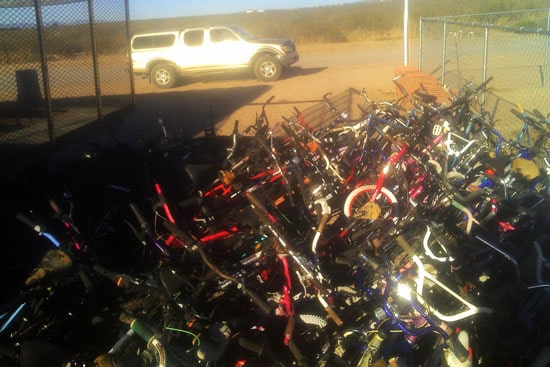
With lots of help from the Unitarian Universalist Church in Silver City along with other Border Partners volunteers we’re outfitting Palomas with 80 bicycles donated by Bikeworks in Silver City, NM.

Bicycling! It’s an efficient, healthy, and inexpensive way to get around town. And Palomas is rapidly becoming a biking community. Bikeworks, a nonprofit community bicycle workshop located in Silver City, NM recently followed up on their generous bicycle donation of last fall with 80 more bicycles this month.

With the help of a wonderful group of volunteers from the Unitarian Universalist Church in Silver City and our weekly volunteer Juan Velasco who helped Border Partners staff load the bikes, we imported this massive donation this month.

Local border residents assisted. Bill Knauss loaned us a truck large enough to transport all of these newly-donated bikes. Don Farber helped us unload them all in the dark, thus making what Border Partners’ Peter Edmunds termed: “the end of a perfect day.” We appreciate all this help!

All needed repairs on the used bicycles will be made by Francisco, a repairman in Palomas. Donations to Border Partners will pay him, thereby providing local employment, and will also supply the necessary bicycle parts.

These bicycles will augment the weekly community bike ride that the local health promoters lead every Saturday afternoon in Palomas.  These promotoras arrange that 20-30 of the donated bikes are available for the weekly ride so that people who do not own bikes can participate.

Palomas community members can “earn” themselves a personal bicycle  by volunteering at the bike ride or on other Border Partners’ projects, for instance, by assisting in the community garden project.

We’re hoping soon to be able to build a covered bicycle storage garage to protect them from the weather.  Donations toward this project are welcome and would facilitate this goal. Donations can be make online on our website or sent by check to our office. Donations can be designated toward particular projects–like the future bicycle storage facility.

Upcoming bike events are already scheduled for this spring. This includes a bide ride on April 14 and the construction of a dirt bike track by Palomas schoolchildren on May 14.
donated bikes

We’ll rehabilitate these donated bicycles that arrived in Palomas.


Palomas garden program now generates funds through local sales

fresh produce

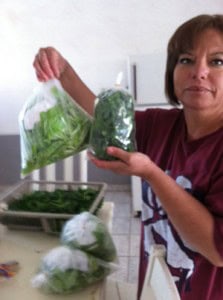
Gardening coordinator Juana Flores shows the packaged produce which is ready for sale.

Border Partners’ gardening program now sells locally grown produce, marking another step forward for the citizens of Puerto Palomas. Our local producers and gardening promoters now offer fresh produce weekly at Palomas stores and restaurants.

The program began last month and sold offerings including a variety of lettuces, spinach, chard, cilantro and parsley. The Pink Store, the large downtown tourist restaurant and vendor of Mexican artisania, placed the first major order for the garden produce, using the very fresh products for a large party they hosted. Since then, Memo’s Grocery and interested individuals have been returning customers.

Vending local produce allows the gardening program to raise funding that will supply seeds, equipment and support to local gardening families. This will support sustainable programming and help the gardening program expand to involve new families that want to participate.

Local leaders of the gardening program–Juana Flores, Juana Lozoya and Helena Myers–prepare harvest, prepare and package the produce for sale.

Because locally produced, organic produce provides improved nutrition and reduces risk of health challenges associated with chemicals sometimes used in commercial production of produce, these sales offer a healthy alternative food source to the border community.

According to Helena Myers, the gardens are currently being re-planted to grow spring crops. As soon as the new crop is ready to harvest, sales will resume.

“Possibilities are expanding,” she remarked.

Palomas health promotoras open a new office

new office

Promotoras of health in Palomas, a grassroots corps of community volunteers to improve health, have opened a new office, providing a permanent presence. They provide health services such as blood pressure monitoring, as seen here.

The community health promoters (promotoras) of Puerto Palomas have opened an office to serve as their headquarters as well as an office from which they will serve the public. Centrally located in Palomas, the office allows the promotoras to offer regular office hours to the public. Promotoras will provide health services of blood sugar monitoring and blood pressure testing and provide health information there. All services and information are free of charge.

The new promotora office is clean, attractive and outfitted with health equipment and literature. Tables and chairs offer an environment conducive to health education meetings. With a computer and printer, the promotoras are able to produce documents and administrate their program. For a virtual tour of the new health office, visit our photo set on Flickr.

posting signIn a small community like Palomas, word of mouth will quickly spread the news of this new source of health assistance, consultation and first aid. However the promotoras also proactively engaged local artist Dagoberto Rodriguez to produce a display sign to clearly designate their office. We were on the scene to see the sign installed.

The promotoras designed a plan of action for 2014 which outlines their ambitious goals and upcoming activities. Ongoing fundraising will let them carry out their projects and potentially add internet service to their office. Promotoras seek that ongoing financial support from the Palomas business community.

The promotoras have also done a remarkable job of securing the contributions of pro bono services for Palomas children in need from local dentists and opticians.

The Columbus Luna County Palomas Binational Health Council (COBINA) provides major funding for the promotoras activities in Palomas.  Border Partners supplements that funding by matching the contributions that the promotoras themselves raise in Palomas. Border Partners is proud to provide financial help to underwrite these activities that improve public health. Donations to Border Partners that are designated to further the promotoras‘ work are welcome.

Promotoras sponsor successful October Health Fair

blood pressure check

Promotoras offered free blood pressure checks for all at the October Health Fair.

Our health promoters [promotoras] sponsored a free health fair at Pancho Villa Park in Pto. Palomas this month on Friday, October 4 and Saturday, October 5. With financial assistance from the Columbus, Luna County-Palomas Binational Health Council and donations from businesses in Pto. Palomas, they were able to provide a wide variety of health-related activities, open to all at no cost to participants.

Mayor checks gluose

Pto. Palomas Mayor Chacon visited the booth to have his glucose checked.

In addition to the blood pressure screening (as seen in the photo at the top of this post, the  promotoras offered blood glucose screening and a wide variety of written health information.  They also arranged for free haircuts to emphasize the importance of personal hygiene.

Local participants enjoyed nutritious, healthy, and delicious home-made burritos, composed from whole wheat tortilla, beans, veggies and cheese. There were games for the children, and zumba dancing for everyone!

Even the local dogs could benefit from free rabies shots at the fair. It was an activity that assisted their owners, too.

On Friday, a mobile health clinic staffed with a doctor, a nurse, a dentist and free medications arrived from Chihuahua City to serve the Health Fair attendees.

The promotoras were outstanding in every way, including their professional appearance in red shirts and name badges.

Click HERE to visit our Flickr set to see photos of many aspects of this wonderful event.