Home-sewn art bags bless young readers in Palomas, Mexico

Prairie Small

Prairie Small displays some of the 100 bags of art supplies that volunteers made and filled for Palomas students.

Supporters from Gila, New Mexico recently delivered another project to support the literacy and the creativity of the children in Palomas elementary schools.  Prairie Small, an inspired volunteer, organized local sewers to fashion individual student bags to house a gift of art supplies and materials for the young students. Barrett and Sebert Brewer helped her collect and purchase supplies to fill those bags.

Ford elementary students

First graders at Ford Elementary School, with teacher Rubi Payan (left) and Border Partners volunteer Tami Edmunds, benefit from volunteer's donations.

Working with children at all three primarias (elementary schools) in town, Palomas instructor Thalia Romero immediately saw how useful the bags would be. A specialist teacher, Thalia integrates art with reading instruction, increasing literacy by integrating art activities into the reading program. Her students, for instance, actually make and illustrate story books to generate interest in reading. She joyfully put these colorful bags of art supplies, lovingly sewed by local supporters, to immediate use at all the primary schools.

Last year these same supporters from Gila brought large bins of glue, paint, and paper to donate to the school literacy/art program. As a follow-up to that project, this year’s colorful, home-sewn bags of supplies –delivered just a few weeks ago–will go to individual children. However, because there are so few school and art supplies at the Palomas school, they will first be used at school for classroom instruction.

Prairie has another idea in mind for her next Palomas project. And we’ll be happy to help make her dream a reality. The students in Palomas have so little that basic school supplies are a special blessing to them. These beautiful bags are a real cherished “extra.” We are so grateful to Prairie, Barrett, Sebert and all their helpers for the joy they brought to young Palomas readers and artists-in-training.

supplies received at Ramon Espinoza school

Barrett and Sebert Brewer helped collect supplies to fill the bags. Principal of Ramon Espinoza Villanueva Elementary School Raul Juarez and Prairie Small are pleased with the project's results.

Border Partners assists air quality assessment of Palomas, Mexico border region

installation of air quality monitors

Edgar Mendoza installs an air quality monitor in Palomas.

Our U.S.-Mexico border region of Chihuahua-New Mexico is now bejeweled with six new air quality monitors.  Border Partners is currently participating in a study of border air quality conducted by New Mexico State University, funded through a research grant administrated by NMSU Professor David DuBois.

The devices are located on electric poles 10 feet above the ground and will remain in Palomas for the duration of the study. The monitors’ automatic timer collects dust and other air pollutants at 24 hour intervals. Those filters are then collected and replaced every other day, a total of 16 times. Border Partners will service the monitors: collecting and replacing the filters, then delivering them to the researchers.

Palomas residents Marisol Guillen (a Border Partners promoter) and Edgar Mendoza assisted with the installation of the air quality monitors and will continue to help with the project’s data collection. Air quality is also being monitored on the U.S. side of the borderline in Columbus, NM.

The information that this study yields will help researchers assess the air quality of the border. Because border crossing traffic is funneled into our area, more air particulates could be concentrated here, too. Several of the Palomas monitors are located in the stockyards area to assess the impact of livestock manure on air quality.

collecting scientific data on air quality

Marisol Guillen dons gloves to collect scientific data on air quality.

The quality of the air we breathe directly affects our health. Participating in this project will help us better understand our border’s environment and the special needs we may have as a result of our area’s international role.

Addressing Mexico’s severe drought with rainwater harvesting and graywater reuse

The severe drought currently cursing Mexico has not spared the northern state of Chihuahua. The drought has already cost farmers more than a billion dollars in crop losses alone and set back the national cattle herd for years, reports Reuters. Experts say this is only the beginning, that Mexico faces a drier future.

Van Clothier

Van Clothier (Image source: Amazon)

The grant we’ve received from the Border Environmental Cooperation Commission allowed us to bring a regional expert on water conservation to Palomas this month. Van Clothier, a certified water harvester, taught us about rainwater harvesting and graywater reuse possibilities for Palomas buildings. Van is the author of Let the Water Do the Work: Induced Meandering and owns Stream Dynamics, Inc., a watershed restoration business located in Silver City, New Mexico.

Van’s expertise helped us assess the suitability from among several houses for the graywater re-use systems we’ll be constructing. He also helped our team evaluate the entire block of property that houses the public library and the funeral building the town has allowed Border Partners use to house our woodworking shop.  His consultation is a prelude to setting up rainwater harvesting and shaping the land so that the water flows to the trees on the property.

Van suggested some simple ways to form what amount to rainwater gardens. We’ll construct depressions in the land to catch rainwater flow. Plants can then grow around the perimeter of these rainwater basins. Alternatively, a tree can anchor the central position in the rainwater garden if it’s established so as to protect the root ball.

An added bonus is that the BECC grant will enable us to hire several people from Palomas to work on the project. This gives the town a boost economically and is a welcome income source for local families.

Van Clothier gave us lots of ideas and, best of all, we learned that some of what we want to accomplish will be simpler and less expensive than we originally thought. That’s priceless information as we prepare for more dry years to come.

Making the Palomas, Mexico desert bloom: Border Partners’ garden promoter is “peachy”

Palomas, Mexico peach tree

Peach tree is in full bloom in Palomas, Mexico. Thanks to Juana and Border Partners there will be many more.

Border Partners’ garden promoter is quite literally doing a “peachy” job; she’s making the desert soil of Palomas, Mexico bloom. A recent visit during a spring garden tour verified that the peach trees are in full bloom in Juana Lozoya Ortega’s home garden.

Juana readies peach saplings to share with Palomas gardeners.

Juana readies peach saplings to share with Palomas gardeners.

Juana is carefully cutting slips from her initial peach tree and rooting them. When they are ready, she plants them in soil and watchs them launch into seedlings, then saplings. She’s founding a veritable orchard to share with her neighbors.

The blossoms are lovely, and they pop against the deep blue desert sky in the blinding Palomas sunshine.

But, even more mind-popping is the story of how Juana began this project: she planted a peach pit seed.

This is the resourcefulness that characterizes the people of Palomas. They will transform their town.

We are proud of Juana’s abilities and respect her generous heart. And we admire her ingenuity and resourcefulness.

Even a lowly peach pit can be put to good use.

Juana Lozoya Ortega

Juana Lozoya Ortega (left) consults with a Palomas gardener about spring planting.

Fostering business in Palomas: Welcome, El Boton Loco!

Smiles greet you at El Boton Loco

Marea's beaming smile greets shoppers at El Boton Loco, newest business in Palomas, Mexico.

When local artisans decided to launch a downtown business to sell their crafts in Palomas, we at Border Partners were happy to provide them some support. Peter Edmunds found building materials to create a “back room” for the women to use for an office and workspace and some donated pink paint to freshen the appearance of the storefront. The store is neat, clean and filled with cheerful sunshine.

storefront for El Boton Loco

Pink paint trim came courtesy of Border Partners, who found some mis-matched paint to freshen the exterior.

The store, called El Boton Loco [Crazy Button] is up-and-running now, selling not only handmade crafts but also crafting supplies for other do-it-yourselfers. It’s located on the east side of the main street of Palomas on the south end of town.

Border Partners is also actively recruiting the donation of a used golf cart to transport U.S. tourist/customers up and down the main street of Palomas. That will increase the flow of  purchasers to this and other businesses. Do contact us if you have any leads on a potential golf cart donation.

Fostering economic development, one of Border Partners’ key missions, is also one of its most challenging goals. We congratulate these women-workers who are leading the way, equipped with their ambition and hard work…and supported by Border Partners.


The people of Palomas, Mexico will transform their town

Political sign reads: We will transform Palomas.

Political campaign sign reads: "We will transform Palomas."

By Polly Edmunds, Cofounder of Border Partners

Last week I finally took a photo of a political campaign billboard on the street in Palomas that caught my eye last year. It reads: Transformaremos Palomas (We will transform Palomas). I believe that Palomas citizens will transform their town and that the contributions of many caring and committed activists will make those changes happen.

That very day I met several such people.

We spoke for the first time that afternoon with the new Acting Director of Escuela Ignacio Zaragoza: Prof. Mefiboset Trejo Tirado. Border Partners is providing a food supplement to augment the meager food supplies  they receive from the government to feed their school children.  He was grateful that, because of our food donations, many of the children would eat at least one good meal during the day.

The children in this school suffer many challenges. A significant number of their mothers have worked as prostitutes. Many of the children may have been affected by alcohol use during pregnancy, so they have additional behavior and learning problems. Prof. Tirado told me that Palomas has more incidents of child abuse than do other parts of Mexico. (To address this social issue, this week the school will sponsor a program about child abuse for the children, with special speakers and videos. This example of compassionate concern for the children’s well-being will affect coming generations.

Librarian meets with Border Partners

Polly Edmunds (left) learns of upcoming opportunities at the Palomas public library from librarian Benita Saenz.

At the town library, we met with another energetic person working for change in Palomas.  Benita Saenz, the librarian and Border Partners board member, told us that she’ll co-lead classes with a Palomas psychologist for parents at the Secundaria (Middle School) on parenting topics such as instilling values in children, sex education and bullying.  I have not heard of another parenting class offered in Palomas.

The library is also offering, for the first time, a free literacy class: two weeks for three hours each afternoon. If it meets a need, they will extend the classes, providing an opportunity for adults to learn to read and write—opening new doors to them and augmenting their own dignity. Educational empowerment will transform Palomas.

Earlier in the week, Benita submitted a grant proposal to the Mexican Environmental Agency seeking funds for a group of women she has formed to start a business building papercrete blocks (with the help of Border Partners).  These funds will help them start a business where they can make money in order to fix their houses that are badly in need of repair.  Of course, they can also use the blocks they make for some of their repairs! If successful, this grant will effect much positive change.

cold frame garden in Palomas

Gardening promoter Juana Lazoya reveals fresh greens growing in one of many new cold frame garden plots in Palomas.

And Juana Lazoya, Border Partners’ Palomas gardening promoter is “greening” the town. We toured not only her own extensive vegetable garden, orchard and greenhouse but also several other vegetable gardens at family homes in Palomas that are now producing bountifully with her support. Juana is making change happen right this minute as she empowers families to grow healthy food by reviving and implementing forgotten agricultural practices.

We the people can make a difference. Our collective power is transformative.

Never doubt it:  the people of Palomas will transform their town.

It is already happening.


New papercrete greenhouse helps Palomas gardens grow

new seedlings ready to plant

Juana presents a flat of new seedlings ready to plant in a family garden.

By Helena Myers, U.S. Garden Coordinator for Border Partners

Well, it’s happening! Juana’s greenhouse made of papercrete is finished, and plants are sprouting in Palomas.

Our Palomas garden coordinator Juana Lozoya Ortega and her husband Fernando, along with Peter Edmunds and his crew built a papercrete greenhouse to support our Palomas home-gardening efforts. Now buckets and large pots hold plants sprouting in the greenhouse’s warm, sunny environment.

Juana recently took a flat of seedlings the greenhouse has already yielded to a beginning gardening family (see photo atop post). Now those seedlings are all nestled in a new family plot that’s surrounded by cement blocks and covered with plastic.

Our gardening program now counts 16 serious, active gardeners who have plastic-protected beds of at least 4×4’ dimension. They’re already harvesting greens and radishes.

Juana & new papercrete greenhouse

Juana stands proudly in the new papercrete greenhouse.

Juana supports the Palomas gardeners with materials: seeds, compost, wire and plastic. And she continually searches out new gardeners, finding two more in the past two weeks. The enthusiastic gardeners are so proud of the plants they’ve grown from seeds sown in December that they hesitate to cut them. We encourage them to harvest them for salads because, if they leave an inch or more, the plant will grow back.

Palomas residents are familiar with tomatoes, chilies or vegetables that thrive in summer heat. But we plan to gather all the gardeners at Juana’s and make a big leafy green salad to demonstrate how to use winter greens because they are not familiar with fresh uncooked winter vegetable usage. Our plan is to keep gardens producing all year, so eventually people can eat nutritious food without going to the store, where they can only find wilted vegetables.

Last month an expert gardener from Columbus brought soil samples to demonstrate soil improvement methods to our Palomas gardeners. She explained the process of mixing biochar with manure to prepare it to serve as a soil amendment. Fernando is presently now watering and weekly turning a large compost pile, using manure from the stock yards mixed with biochar.

Palomas gardeners

Palomas gardeners help Mother Nature grow their food.

Our future plans are to attempt to propagate fig tree cuttings for all the gardeners and to begin to establish peach tree cuttings. We’re also looking forward to implementing the grey water systems that will result from the new environmental grant Border Partners received. Two gardeners already use water from their washing machines to trees in their yards, so this will extend the water conservation efforts we’ve already begun.

It is an exciting time of new growth in the gardening sector of Palomas!

BECC Grant to Border Partners will conserve water, grow crops in Palomas

water conservation

Grant conserves desert water. Photo: Microsoft Images.

Border Partners received a grant for  $10,000 from the Border Environment Cooperation Commission last week. This is exciting news to our fledgling organization, as it is the largest single grant award we’ve received to date.

The funding will allow us to build graywater reuse systems and rainwater harvesting systems in Palomas. We’ll be able to install systems at 15 residential homes and also at the public library this year.

Along with this project, the BECC grant will fund the construction of a model bathroom that will demonstrate water-saving technologies appropriate for the desert environment.  The model will include a system to reuse the residential graywater–drainage from the sink–on a garden. It will also utilize solar hot-water heaters.

from the BECC website:

U.S.-Mexico Environmental Program (Border 2012) is a collaboration between the United States and Mexico to improve the environment and protect the health of the nearly 12 million people living along the border. The bi-national program focuses on cleaning the air, providing safe drinking water, reducing the risk of exposure to hazardous waste, and ensuring emergency preparedness along the U.S.-Mexico border.

Border 2012 is a results-oriented program that takes a “bottom-up” approach to addressing the environmental and public health needs of the border region.  Issues and projects are identified and implemented at the local level.

Border Partners is proud to be working with this bi-national program. By conserving water and promoting sustainability, we’re helping to create a new model for future viability on the U.S.-Mexico border.

Border 2012 map

Border 2012 area map. Courtesy: EPA website.

“Mission Accomplished” as Palomas boasts a library playground climber

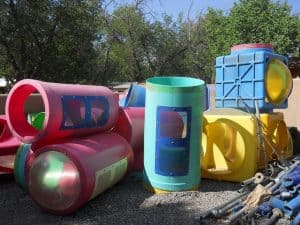
New playground climber at Palomas library delights children and keeps them healthy.

“Assembly Required”

A new playground climber resides next to the public library in Palomas, Mexico. It crowns the efforts of a long and sometimes complex process–a process that involved literally dozens of volunteers to accomplish.

Last year Border Partners founders Peter and Polly Edmunds stumbled upon a U.S. playground climber that was destined for the landfill. Due to building construction, the climber was scheduled to be demolished. They had to ask: Could they have it for Palomas?

The answer was “yes”–if they could deconstruct and remove it before the bulldozers arrived. Volunteers from Deming, who responded on the spur of the moment, were critical in figuring out  how to get it apart.  Lacking a caterpillar to get the high piece off, someone invented a rope system to get it down.

Storing and transporting all the pieces across the border was another step in the process. Finding a place to store them in Palomas–they got that done, too.

But the final piece–reconstructing the structure–well, that was the real challenge. It involved a devoted crew and even a caterpillar to assemble the behemoth! It was like a three dimensional jigsaw puzzle, composed of rather weighty pieces.

The fruit of all this now stands proudly aside the Palomas library, where each day literally dozens of school children come to read, to use computers, to socialize in a safe environment…and now they can also recreate.

Papercrete adds value to a Palomas home

completed addition

Papercrete addition to Palomas home adds value economically.

Home readied for addition.

Palomas home is readied for a papercrete addition.

Papercrete is a building material that is gaining acceptance because its production recycles paper products for construction uses.

Just as importantly, papercrete provides improved insulation. According to Wikipedia, papercrete’s R-value is within 2.0 and 3.0 per inch. And since papercrete walls are typically several inches thick, that provides great insulation from summer sun and cold winter winds.

papercrete walls

Papercrete block is used instead of cement block.

Unlike concrete or adobe, papercrete blocks are lightweight, less than a third of the weight of a comparably-sized adobe brick. This is because the paper fiber replaces the sand, clay or gravel component found in adobe or cement.  Papercrete is also mold resistant and also assists sound-reduction.

For all of those reasons, Border Partners is promoting papercrete as a potential boon to Palomas. A local family used papercrete blocks to add a room to their home this month. The photos illustrating this post show papercrete in action!

finishing exterior

The exterior of the walls receive a protective finish.