Battling Disease on the Frontlines: In our Border Community

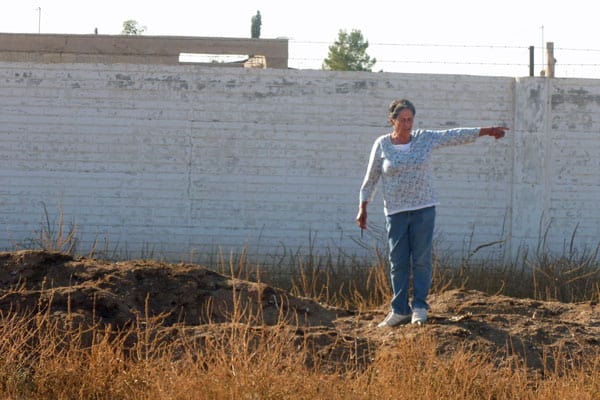
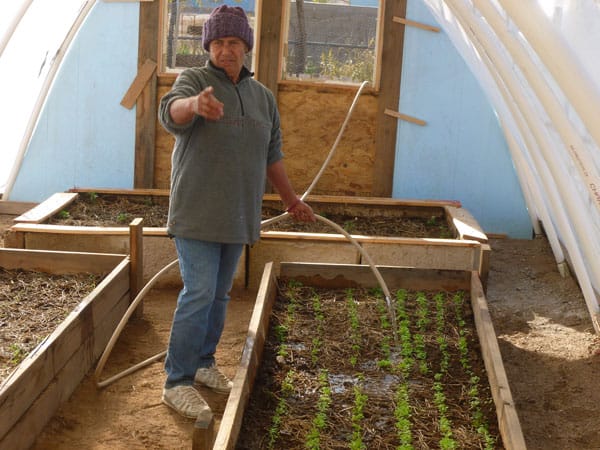
Gardening coordinator Juana Lazoya stands atop a compost pile indicating the span of soil created to enrich the home gardens carved from the desert sands of Puerto Palomas.

Gardening coordinator Juana Lazoya stands atop a compost pile indicating the span of soil created to enrich the home gardens carved from the desert sands of Puerto Palomas.

A recent opinion piece in the Deming (NM) newspaper, the Headlight, highlights the severe health needs that affect our border community as well as all of Latin America.

from the Deming Headlight: Writing last week in The Guardian, Ramon Vera Herrera blamed free trade for the obesity and Type 2 diabetes epidemic ravaging Mexico, Central and South America.

“Today, many countries in the global South are seeing an explosion of these afflictions — all because their governments welcomed in transnational food companies looking for new ‘growth markets’ for poor quality, heavily processed or just plain junk food,” Vera Herrera wrote.

Vera Herrera said that the North American Free Trade Agreement, signed by President Clinton in 1993, destabilized Mexico’s food system — in terms of loss of economic stability, the undercutting of local food producers’ profits and, in many cases, the gobbling up of land by huge agricultural companies.

These are major reasons for Latin Americans’ skyrocketing incidences of malnutrition, obesity and associated diseases, he says.

Continue reading the opinion piece on the Deming Headline website.

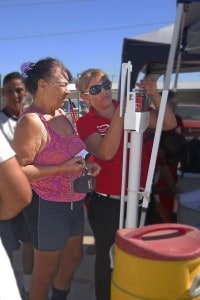
Health promoter checks weight at a health fair. Knowledge is the first step in fighting disease.

Health promoter checks weight at a health fair. Knowledge is the first step in fighting disease.

The supporting information in the Headline’s opinion piece– the statistics and stories– demonstrate exactly why the people in Puerto Palomas are so interested in having Border Partners’ assistance. We help them build home gardens and establish other infrastructures, such as greenhouses and composting sites. With this support it’s possible for them to grow their own food. This helps their families avoid the health problems of malnutrition, obesity, hypertension and other associated diseases.

In addition, our water filter makes it possible for schools and families to have safe drinking water in their kitchens. The Mexican government provides only two sites where people can pick up clean water to haul back to their homes, common building and work sites. And, they must pay one peso per liter for that clean water.

Your support makes our assistance possible. Thanks for preventing diseases and supporting healthy water.

Education Center hosts Mental Health Training Program for the Borderlands

mental health class

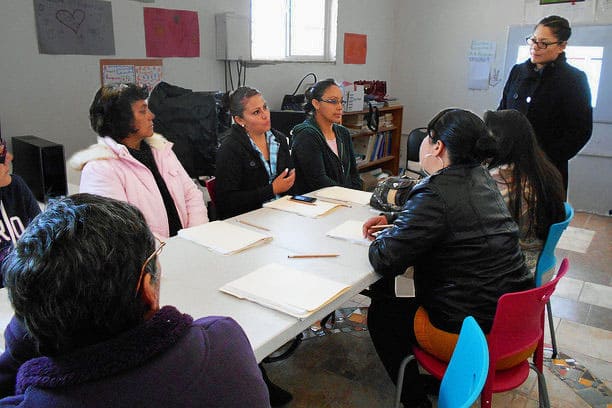
Monica Chavira, a Mental Health Consultant based in Juarez, Chihuahua, led an adult education course on mental health in February.

Monica Chavira, a Mental Health Consultant based in Juarez, Chihuahua, lead a Mental Health GAP Training February 26-27 in Puerto Palomas. Nineteen adults attended this two day training, from 9 AM to 5 PM each day.  The program was sponsored by the US-Mexico Border Health Commission and the Paso del Norte Health Foundation. All our local health promotoras participated in the training, with the addition of 13 other residents of the community.
This was a wonderful opportunity to strengthen important skills in an area that has suffered trauma for many causes, including past violence from drug and gang related causes.
“I learned how to identify people with mental disabilities and how to refer them to receive primary care.  This training will improve my ability to serve my community.”
“I learned how to identify a person with a mental disability and what risks they pose.  Other things were how to relax and be calm, how to treat an alcoholic person and how to assist anyone from our community.  I liked this training very much.”
“I learned how to listen to another person and help them identify their problems.”
The training was based on the Mental Health Gap Action Program (mhGAP) Intervention Guide for mental, neurological and substance use disorders in non-specialized health settings that was developed by the World Health Organization (WHO), adapted by the Substance Abuse and Mental Health Administration (SAMHSA) and facilitated with support from the Pan American Health Organization (PAHO).
Our two-day workshop was part of a regional effort that included nine local nonprofit organizations. Overall, over 250 adults participated in the program. It focused on community and substance use disorders in non-specialized health settings. It also provided community health workers basic training in mental health screening and referrals. The training also included how to monitor and follow up with people with mental illness and their families.
We’re delighted to see our new Education Center used as the site for fine adult programming like this. Strengthening mental health skills will improve the community of Palomas.

Business plan seminar attracts adult learners in Puerto Palomas

business plan seminar

Border Partners volunteer Juan Velasco [standing] engages adult learners in the process of writing a business plan during the first class of his seminar in Puerto Palomas.

by Suzanne Dulle

Residents from Puerto Palomas took another step toward fostering economic development and sustainability in their own community on Saturday, February 7 by attending the first of five sessions of a seminar entitled, “Developing a Business Plan.”

Eleven enthusiastic adult learners gathered in the new Education Center to listen to Border Partners volunteer Juan Velasco launch his much anticipated class. All the participants are currently running their own small businesses or are aspiring to begin their own “empresas” in Palomas.

Business plan seminar scope

The class will also include presentations from local professionals to ensure that participants not only learn good business practices from the US point of view, but are also updated on Mexican laws that regulate businesses in their own country.

Velasco, a native of Bolivia, has over 25 years experience in managing his own business, and spent 10 years assisting small businesses and teaching business development seminars in Santa Fe, NM.

Winter in the cold high desert challenges Border Partners to help

3 children model winter hats

Thanks to Morningstar of Silver City, NM some vulnerable children are more warmly dressed for winter’s challenging weather.

by Peter Edmunds, Border Partners co-founder

Winter brings special challenges. Here in the Chihuahua Desert, at an altitude of 4400 hundred feet, temperatures fall to near or below freezing every night more than three months every year. For us northerners with insulated, heated houses that’s not an issue. But, in Puerto Palomas it’s seriously cold.

Their cement buildings with metal roofs have the insulation power–or “R value”– of a beer can. The only building in town that seems adequately heated is the mayor’s office. Schools and the library are only minimally heated. Homes are often entirely without heat.

Thanks to our generous donors Border Partners has been able to help address this challenge this winter!

Meeting Winter Challenges

Consider, for example, the situation of Raymundo, a senior citizen who lives in a windowless, one-room building that’s heated with a wood stove without a chimney. Our local program director Juana met him one very windy day. His metal roof panels rose at least a foot off the rafters with each gust of wind, letting out some of the smoke. Some volunteers, equipped with boxes of screws, some stove pipe, a warmer coat and a blanket, have made his life a bit easier.

One donor contributed two boxes of kids’ coats. Every time I see a Tarahumara child with a good winter coat I whisper a silent thanks to that donor. We gave that community of Native Americans over 30 coats.

A group of volunteers from Western New Mexico University winterized a house where a mom and her three kids live. Last year, those volunteers replaced seven broken windows, filled a 4 foot diameter hole in the wall that was covered by a blanket, and finished putting metal panels on the roof. That mom had an eave trough running across her living room ceiling to catch the rain water that leaked in along the seams of the plywood!

Donors help us help

The home run of this winter was receiving a pickup load of sweatshirts donated by a local company–Morningstar in Silver City, NM–that stencils team shirts. Near as I can guess there must have been over 300 shirts on the load, mostly nice hooded types. The last box I opened had about 40 small sized knit hats. The photo of three children at the top of this post shows those hats in action.

A Deming woman gave a whole box of hats she knit herself. I see them all over town, easily identified by the colors she used.

I brought a door down on yesterday’s load, and it never even made it into our store room. While we were unloading, a mom showed up who needed a 32 inch door. We even had a hinge and lock set to offer her from the bucket of hinges an unnamed grandpa gave us last summer.

More effort upcoming

Several groups that had offered assistance to the town of Palomas in past winters with warm coats and clothing now have left. In the Fall of 2015 we will try to step in to fill that void with an organized effort to offer that assistance. Here’s our call out to all the knitters and crocheters: get your needles and hooks going! Help us help.

We have the best donors in the world. With their support, Border Partners can help meet the challenges winter throws at the folks of Palomas.

Puerto Palomas Health Promoters focus on children with special needs

child development classes

Mothers receive training on how best to support the development of their children with special needs at child development classes in Puerto Palomas. Our health promoters augment this effort and participate in offering the classes.

The health promoter [promotora] group of seven women works closely with the staff of the town’s Health Center [Centro de Salud] to extend health education and health enhancing activities into the daily lives of the townspeople. Border Partners, which provides direct support and resources and finds training opportunities for these women, is pleased with their recent new focus on assisting families of children with developmental disabilities and special needs.

As part of this effort, the promotoras visit homes of families identified or considered likely to benefit from these supportive services. The promoters conduct a health survey, appearing at the doors of the families and asking to visit the parent(s) to conduct a short interview. They

Dra. Lina Carrasco

Doctor Lina Carrasco (top) of the local clinic in Puerto Palomas demonstrates to moms how best to promote child development.

inquire as to the needs of the household, asking, for instance:

  • Do any of the children have special needs?
  • Are the children moving, walking, speaking, responding appropriately for their age?
  • Would the household benefit from receiving a food supplement basket?

Questions are suggested by the Mexican government and responses recorded for the town clinic.

As a result of the survey, families have already experienced benefits. Infants and children with motor disabilities, for instance, are receiving direct assistance at classes that teach parents how to stimulate greater development. Gricelda Loya, local leader of the promotoras, reports that even one class session can produce rather dramatic improvements in infants. Early identification and early intervention can promote lasting improvement.

Gricelda trained in Casas Grandes, Mexico to learn the stimulation exercises that they are teaching the mothers.  She has subsequently taught some of the other health promoters who have added this project to their regular activities which include:

  • regular hours at their Palomas office during which they can provide health advice, check blood pressure and glucose levels and make referrals to the Centro de Salud;
  • monthly visits to the town meal site to check blood pressure and glucose;
  • twice yearly health fairs;
  • assisting clinic staff with registering families for services.

This weekend they will administer flu and tetanus vaccines at the Christmas event in town.

Photos by Gricelda Loya, leader of Puerto Palomas health promoters

BONUS: Photos of moms, children and healthy learning on our Flickr Album by Gricelda Loya

Water filtration project provides safe water to Puerto Palomas

water filtration workshop

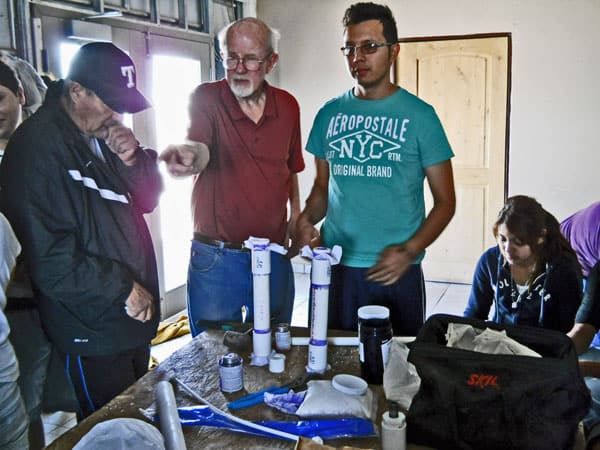
Border Partners founder, Peter Edmunds (center) helped Juan Carlos Huerta (right) of Puerto Palomas lead a workshop to produce water filters for testing.

Public drinking water in Puerto Palomas contains naturally occurring heavy metals that are detrimental to long term health, particularly for children. Levels of arsenic surpass 20 times safe standards; there’s seven times too much fluoride.

The town provides two public water filters but residents must pay 1 peso per gallon for the safe water. Regularly transporting large jugs of water to one’s home is time-consuming and heavy–as a five gallon jug weighs over forty pounds.  And the amount of water needed in a school for the drinking needs of students, staff and for lunch cooking requirements prohibits use of this safe water.

Erin Ward, the Director of the Southwest Consortium for Environmental Research & Policy and Joshua Gomez, an engineering student from New Mexico State University, contacted us at Border Partners to introduce a public domain design water filter to Palomas. The filter is composed of common plumbing parts and chemicals.

This filter, which can easily be installed in public buildings and in homes, allows access to safe water to all at a low cost.

Making sure it works!!

Border Partners is working with community members to introduce this filter, run tests to make sure that it works well and to find out how long the chemicals will filter to safe  standards. We needed to find a source for the chemicals and to refine the design to keep the cost as low as possible.  In June, 2014, filters were built by high school students and installed in the community demonstration garden, as well as in the three Palomas public schools. In July, water samples were tested and found to meet the standard set.

Peter Edmunds secured interest from the community, arranged for their involvement, transported water for testing and secured donations to fund the project.

News of this advance spread. The Mayor of Ascension, the county seat,  asked for filters to install in 30 schools in the district and partially funded their production.

Currently, the latest model of the filters is installed in the three schools and the garden.  The next step is to have the water tested by a Mexican water testing lab.    After we clear that hurdle, we will be able to install the filters in all 25 of the schools in the district and sell the filters to the public.

Two men from Palomas are developing a business plan to launch a way to sell these water filters in Mexico. If successful, this will contribute to economic development in the town, providing jobs and reliable income.

New community greenhouse will boost nutrition in Pto. Palomas

greenhouse construction

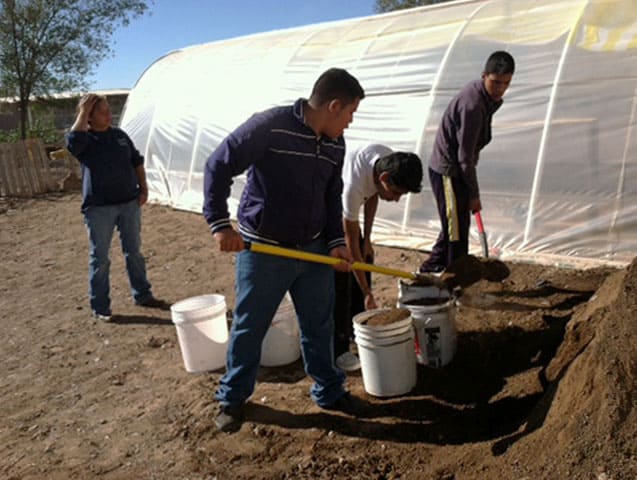
High school students at work preparing soil beside the newly constructed greenhouse in Pto. Palomas.

Border Partners organized and completed the construction of a new community greenhouse in Pto. Palomas this month. The facility will produce fresh vegetables year round. This produce will supply fresh food to the town’s new community meal site for the needy that provides low cost meals to local residents and to the Ford Elementary school.

The greenhouse is a generous 36′ x 12′ hoop house, constructed with PVC pipe and covered with greenhouse grade plastic. It is situated adjacent to the new meal site, on the south side of the municipal library in Palomas, just east of the Border Partners outdoor demonstration garden. It was constructed and will be maintained by Border Partners staff and volunteers from the community, many of whom participate in the Border Partners’ home garden program.

All building materials were contributed by local merchants who responded to the solicitation of BP’s Peter Edmunds:

  • PVC pipe was donated by Sun Valley Hardware in Deming, NM
  • Lumber was donated by Foxworth Galbraith Lumber in Deming, NM

Since there are few high quality vegetables available in Palomas, the greenhouse will significantly improve access to healthy food for the local residents. The Mexican government supplies dry goods for the new meal site and to the school but no fresh food. Access to fresh vegetables will help local cooks prepare tasty, healthier food for those in need.

The main structure was built on Nov. 7, doors and windows were added Nov. 10 and raised beds were constructed and filled with soil that week. By November 24, all the beds were planted. Four local high school students helped with the project for several days, building the raised beds and transporting the compost/soil from Border Partners’ soil making site at the local stockyard to the greenhouse site.

The greenhouse was an international partnership in the truest sense of our mission – to bring together people from both sides of the border to improve life in this little Mexican border town of Pto. Palomas. The Edmunds’ friends from Wisconsin, Peter and Lynne Nason came the greatest distance to participate. As always we are grateful to all who made this project become a reality.

View the project as it developed on our Flickr album: Hoop Community Greenhouse

EDIT: December 13, 2014–The greenhouse is sprouting. See updated photo:

growing greenhouse

Gardening co-coordinator Juana Lazoya waters the sprouting lettuce in newly planted raised beds of the community hoop greenhouse.

Opening and Dedication of Palomas Education Center to be October 18

Education Center

Education Center addition (right) at Palomas Municipal Library.

After years of fundraising and planning, construction and setting up equipment, Border Partners is ready to invite the public to come to the new Education Center of Pto. Palomas!  We hope you will join us for a Celebration and Dedication of the Center on Saturday, October 18!

This Center was made possible by the hard work of many dedicated individuals, groups and foundations!  It is the realization of a dream for many people who live in Pto. Palomas and will stand as a true monument to international friendship and committment.  We are confident that it will serve, for years to come, as a place where people of all ages can come to learn, to advance their education, acquire skills and to communicate with family and friends.

Activities of the day

The event will include an official opening of the Center at 1:30 pm, tours and demonstrations of the Center’s technology equipment, music and refreshments!  In addition, the Palomas Promotoras will hold a Health Fair. Visitors can also view demonstrations of other Border Partners’ projects and tour our large demonstration garden on site.

The Center is located two blocks south of the Pemex gas station [located south on the main street of Palomas] and four blocks west. It is adjacent to the Public Library.

We’re providing free Rides between the Education Center & The Pink Store for this event. Rides will leave The Pink Store every hour at 12:30, 1:30, 2:30, 3:30 and 4:30 and leave the Education Center on the hour from 2-5 PM.

Sponsors and Supporters

The Education Center was produced by donations, hard work and dedication of the following major contributors. 

The Akerson Family Foundation, Albuquerque, NMinvitation

The Rotary Club of Silver City, NM

The Rotary International Foundation

The Town of Pto. Palomas de Villa under the administrations of both

Pres. Miguel Chacon and Pres. Estanislado Sanchez

The Nason Family Foundation

The Rotary Club of Torreon, Coahuila

The Rotary Club of Ramos Arizpe, A.C.

Paul Allen and Billie Greenwood

Suzanne Baraff

Dominick and Sherry Bassi

Sheila Bjeletich

Barrett and Sebert Brewer

Elizabeth and Ted Burr

William Charland and Phoebe Lawrence

Suzanne Dulle

Peter Edmunds and Polly Thomson Edmunds

Martha Egan

Karl and Barbara Giese

Marisol Guillen

Victor and Yolanda Hesch

Caroline Hughes

Kristine Laverty

Dee Ann McIntyre

Helena Day Myers

Richard and Christine Ouren

Thomas Perley

Juan Rascon

Dagoberto Rodriguez

Marcia and John Rounsaville

Juan Velasco

We are very grateful to everyone!


Deming Headlight Highlights Border Partners’ Work in Palomas–Part 1

The Deming Headlight, newspaper of Deming, New Mexico, focused on our work in a series of three articles by Marjorie Lilly. We encourage you to visit the articles on the Headlight’s webpage. For your convenience, we post them here with gratitude to the Headlight.

Business could be booming in Palomas by Marjorie Lilly

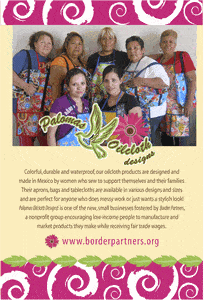
The seven women in Palomas who originally worked for Palomas Oilcloth Designs in 2008 are still working there. It was one of the first projects nurtured into existence by the non-profit organization Border Partners, directed by Polly and Peter Edmunds of Deming.
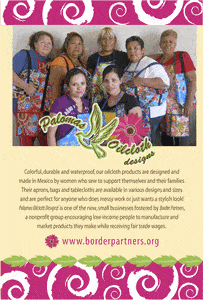
Palomas Oilcloth Designs group

The women make bags, aprons, and tablecloths out of oilcloth printed with traditional Mexican designs of bright colored flowers and fruits.

They sell them at the Pink Store in Palomas, Chihuahua, Mexico, at Mountain View Market in Las Cruces, La Fonda Hotel in Santa Fe, as well as in Tucson, AZ, Duluth, MN and even Australia. They have a website […] where orders can be made, and also on the Etsy website.

The women have paid off their loan to Border Partners and have their own bank account. But they still work with Polly Edmunds to some extent. “She sometimes receives orders and gives them to us,” says Ludy Loya. “She brings our things to stores.”

Palomas Oilcloth Designs started up in 2008, when the violence began soaring in Palomas, a Mexican border town located 35 miles south of Deming. Six years later, the business is still intact, long after the violence has subsided.

The goal of the Edmunds’ non-profit organization has been to promote “education, health and recreation, sustainable technologies and economic growth,” as stated on their website.

The Edmunds are from Minnesota and found the motivation to start their project when they went to Cuernavaca, Mexico after their last child had finished high school.

They visited a town in the mountains “where people lived in houses made from palm fronds and corn stalks,” says Polly. “They had no real source of clean water. We were forever changed from that day forward.”

When Palomas Oilcloth Designs was just starting out, says Juliana Lazca, “Polly brought an apron so we could get an idea of the design. At the beginning we made only aprons.”

They designed the aprons, and then designed almost all the bags.

“If we designed more bags now, it would take too much time,” said Loya, the coordinator for the group. [Border Partners’ note: They will accept custom orders]

“Thank God Polly came to Palomas at that time,” Lazca said.

Polly helped them learn necessary skills like accounting, marketing and purchasing supplies. Ivonne Romero at the Pink Store orders the rolls of oilcloth they want from Mexico City. “We don’t spend a lot of time with Polly any more,” Loya said.

The designs are sunny and appealing.

There are cherries, apples, watermelons, pineapples, chrysanthemums, and sunflowers with a “retro” look, as the same designs have been used on tablecloths in Mexico for decades. They come in red, dark green, yellow, aqua, hot pink, lime green and more.

They used to work together at the building used by Border Partners. “It was kind of a social club,” said Loya.

But the space is now being used as a soup kitchen for the government program called Crusade Against Hunger, so the women just store their oilcloth there and go there to cut off what they need.

They all work mostly separately now, and on their own schedules. One works in her living room, another in the kitchen.

“The only rule is that everybody works the same and for the same hours,” said Loya. “Everybody gets the same amount of money.” They get an average of $50 a week, more in the summer months than in winter, from ten hours of labor. This is what many people in town earn in a week. They earn about $5 an hour, which is a competitive rate in a town like Palomas.

Palomas has been in an unemployment crisis since about 2006, when the U.S. tightened the borders. This shut down a lot of businesses that served illegal border crossers. A factory shut down when the economic recession hit, and the drug violence has scared away medical tourists.

So most of the women are supplementing their family income in a town where there’s a lot of hunger and unemployment. By some estimates half the population is out of work.

Juliana didn’t have a job before, but now she and her husband, who drives a taxi, are building a new house for themselves with the help of her earnings.

Socorro Ortega made “much less” before. She made pastries and sold them from house to house, often not earning enough for her and her daughter to eat. But now she can take vacations and fix her house.

Working only 10 hours a week leaves time for other jobs.

Loya has a beauty salon. Socorrito works as a health promotora for Border Partners.

Berenice works at her mother’s ice cream business.

The biggest order they’ve ever had, says Loya, is when they were commissioned to make 1,500 bags for an international church conference. They worked on the bags from October last year to March this year. They do special orders sometimes too. Requests can be e-mailed to ludyloya@gmail.com.

Loya puts out a request for donations of sewing machines for the group. “Sewing oilcloth is very hard,” she says. “Socorrito was telling me she’s having things [on her sewing machine] break very easily. And we don’t have anybody here who can fix them.”

She describes the kind of sewing machine they need — “the older the better. Old machines are very strong.”

When asked why she continues working for Palomas Oilcloth Designs, Ortega says, “For the money, and because I like it.” In regard to whether they will work there forever, “We hope to God we will,” she says.

Berenice Garrido adds, smiling, “Hasta que el cuerpo aguante” (As long as my body lasts), and they laugh.

A little help goes a long way in Palomas, and the women in the group are still smiling with gratitude.

For donations to Border Partners e-mail info@borderpartners.org

Summer activities in Palomas enthuse Border Partners intern

by Catie Carter

Catie Carter and water filter project

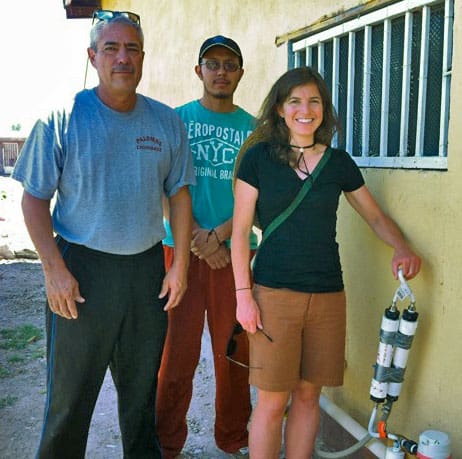
Catie Carter [right], Border Partners summer intern in sustainable technology, displays the important new water filter that Juan Carlos, the high school Chemistry teacher and Joel, the high school Physics teacher,are introducing into the Puerto Palomas community. This water filter will remove toxins of arsenic and fluorides.

Hola! I am Catie Carter, a PhD student in Sustainable Design at the University of  Texas, Austin. I’m volunteering and studying activities here in Puerto Palomas this summer.

I arrived last week and have already met so many lovely people working towards positive change in Palomas. The picture above shows me with Juan Carlos, the high school Chemistry teacher, and Joel, the high school Physics teacher, who are creating a simple and important water filter to distribute through the town, starting with the schools.

This water filter is specifically designed to pull toxic arsenic and fluorides from the water. Right now, the two men are working on a prototype and conducting quality testing. They were excited to show me their work one afternoon.

This project is one of many initiatives that Border Partners supports and that community members and leaders carry out. In my first week here I’ve met many others committed to improving their community:

  • the education center’s neighbor Sam, who now runs a papercrete business;
  • the friendly and fun group of promotoras who promote health, good nutrition and exercise and run the summer school;
  • the enterprising group of women who craft oilcloth bags and aprons for Palomas Oilcloth Designs;
  • the gardeners, working in both a demonstration garden at the center and helping to make home gardening the norm …and even more!

In coming weeks of July, I’ll learn more about the new bio-char projects, solar oven operation, the papercrete manufacturing, solar hot water heaters and other initiatives.

The community has been so welcoming. I’m inspired by everyone’s energy, commitment, and the friendships they have formed.

In the coming years I hope to write a meaningful and helpful dissertation about sustainable design in the Borderlands. My experiences here with Border Partners and the Palomas community will be invaluable in my investigation on change in “the built environment,” the human-made space in which people live, work, and recreate daily.