Paso del Norte Health Foundation awards us a new nutrition grant

Preschool child enjoys healthy fresh food during a nutrition lesson led by Border Partners in his classroom. (File photo)

Border Partners was one of 15 groups in our region receiving a grant under the Paso del Norte Health Foundation’s new program called “Healthy Eating.” We were excited to recently hear this news. This one-year grant will enable our staff to work closely with the schools in Palomas to create an improved, healthy school environment. The grant will focus on nutrition and gardening education, on-site greenhouses, and nutritious meals for students.

Border Partners has done some nutrition education over the past years for many different groups. But we’ve never worked with the focus that this new grant will allow. Each class at every grade level (770 students, K-12) will participate in eight class sessions. Each class session will present a nutrition topic suited for their age and taught by Border Partners’ staff over this next school year.

Each school will have its own greenhouse to grow fresh, healthy vegetables for their students’ lunches. There will be sessions with students in the greenhouses so they learn how to grow vegetables. Each classroom will have a container garden so they can watch plants grow every day. Cooks at the schools will also benefit from sessions with our staff on ways to incorporate the vegetables from the greenhouses into their menus.

We’re training for this work now.  Currently, Border Partners’ staff are learning from professional nutritionists and are preparing lesson plans and materials to use with the students in the classes.

We’re, of course, very grateful to the Paso del Norte Foundation for this new opportunity to improve health in Palomas. Their grants to our programming over the last eight consecutive years have helped us grow our programs and build capacity. We’re confident that this new effort will improve overall health in Palomas, as we help children form habits that will benefit them for a lifetime.

Lily’s Reflections on Her BP Internship

by Lily Eichorst

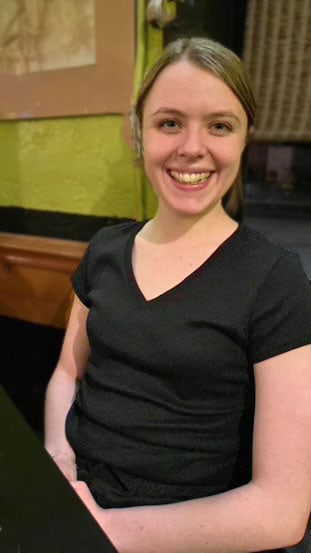
Lily Eichorst

Lily Eichorst

Three months with Border Partners passed in a flash. My time as an intern has officially come to an end. I know I’ll miss the friendly folks (and dogs!) of Palomas quite a lot. But, I’m endlessly grateful for the time I had there, and know that I’ll surely be back to visit.

When I started with Border Partners in March, there was an early spring snow on the ground. I was adjusting to using my Argentine-flavored Spanish in a professional context. (In Argentinian Spanish, the “voseo” form for “you” in English is a both formal and informal address, so you can use it with anyone. In Mexico, I had to remind myself constantly to use “usted” and not “tu” to be respectful to my colleagues!) By the time I left at the end of May, temperatures were creeping up towards the 90s. And, I’d certainly polished my Spanish, while adding a few uniquely Mexican phrases to my vocabulary. ¡Qué padre! (That’s cool!)

Aside from weather changes and the strengthening of certain language capacities, you may be interested to hear what I did during my time as an intern these last months.

Accomplishments

From the beginning, one of my main intentions in doing this internship was an immersive, cross-cultural connective experience. The work of challenging one’s assumptions about a certain context can only be done outside one’s comfort zone. My time in Palomas certainly served to expand mine. It was important to me to seek to understand the dynamics at play in the border region, not as they are described in the news, but by living and engaging with a community on the opposite side of the border. Another important intention was to familiarize myself with the inequalities seemingly inherent and apparent in border communities, the causes of that divide, and best practices for alleviating it.

In finding my footing initially, I was welcomed by BP staff to contribute to a diverse array of activities. These found me doing many  things:

  • I donned a promotora uniform and drove the streets of Palomas distributing meals to local seniors.
  • I interviewed staff and wrote profiles for each team member for the website, and
  • I hauled bags of beans.Significantly, I joined community festivities. These included the Women’s March and the famous Cabalgata, a binational event commemorating Pancho Villa’s 1916 raid on Columbus, New Mexico. This event celebrates the peace that’s existed between the two nations ever since. It features an impressive show of riders on horseback who travel from southern Chihuahua all the way up to Columbus, New Mexico.

Learnings

As time went on, I grasped both the organizational importance of Border Partners as a community actor in Palomas, and the unique cultural fabric of this community through this type of varied engagement. Eventually, I found that my skills were best in communicating with those who could not be present to see or participate in what we’re doing here. So, I became involved in social media and fundraising on the administrative side. I also helped with daily operations since I was working alongside staff in Palomas. This meant occasionally:

  • attending school library inaugurations or municipal governmental meetings on public health matters,
  • helping to organize monthly food and supply distributions,
  • translating plans for new constructions in the garden, and
  • documenting all Border Partners sponsored events, from bike races to community health fairs.

I was also in the unique position to spend some time volunteering with the municipal migrant shelter across the street. That tapped into my interest in migration as an academic study by bringing the personal dimension to the fore. I’m particularly interested in the social construction and heavily securitized reinforcement of the border, even as transcendent issues such as climate change threaten ecosystems, livelihoods, and entire populations indiscriminately.

BP Makes a Difference

Lily Eichorst (top,left) worked with the promotoras to gather and enrich the lives of local isolated senior citizens in Palomas.

Where the policy response is lacking, the areas where collaboration on these issues exists locally, between empowered communities operating on any one side of the border, becomes vital. That’s one reason why Border Partners’ emphasis on resource-sharing resonated so deeply with me.

I became eager to contribute to project development on the sustainable technology front. I was able to collaborate on a project proposal to expand the existing efforts to heat homes with biochar, an emissions-free energy product and fertilizer made by burning pecan shells, which the region possesses in over-abundance.

During my time with Border Partners, I contributed to a diverse set of projects and met passionate people with a drive to improve their community. I also observed how integral this long-standing work–particularly in project areas such as public health–has been for Palomas. Border Partners can certainly be described as a stalwart for community empowerment.

I’m grateful to have called myself a part of the team for the last months. That’s a drop in the bucket of BP’s more than 15 years in Palomas, but it’s enough time to make a change both within and without.

Engaging with the community both through and outside of my work enriched the experience tenfold. Simply calling Palomas ‘home’ for the last several months did, too.

Lily’s Announcement

Although I’m now back in Germany to complete my studies, I’m pleased to say that I’ll continue my work part-time with Border Partners remotely as a Development Associate! I’ll be busy behind the scenes working on the fundraising team.

But, you may also see occasional posts from me on the website and weekly on social media. Additionally, I’ll be working to launch a new sustainability information sharing section here on the website. So watch for the first installment on biochar in the coming weeks.

If you have additional questions about interning for Border Partners, don’t hesitate to reach out to me at lilian@borderpartners.org. I’d be happy to get in touch!

How recent food distributions make a significant difference in Palomas

Border Partners’ José Luis Muñoz hands these women-led, indigenous families important basic supplies in a recent food distribution.

Each month this spring Border Partners organized and executed food distribution drives. These significant efforts began at the onset of the pandemic in 2020. Since then, we’ve regularly helped those who are most in need in our Palomas community area with a nutritional supplement. Most recently, eighty food baskets blessed 246 people, including the most needy families and seniors. Determining who needs these important nutrition resources is done carefully.

Thirty  family recipients receive a dispensa, or food distribution, from us every single month. We selected these families after conducting an annual survey that included direct home visits. These families are, in our judgment, the most needy, the most vulnerable, and the ones with the fewest resources and supports in Palomas.

People in Need of Food

But each month we also give assistance to additional families who others recommend to us as needing extra help. In May, for instance, we gave boxes to fifty additional families. These referrals come to us in a variety of ways. Sometimes, teachers will suggest a family that they know is struggling. Staff members hear of other families who need the help. Or, the community health clinic may suggest names.

More than half of the supplemental food basket recipients are headed by single adults or are individual elders. These are typically either single mothers or seniors who live alone.

How We Help

It takes time and teamwork to gather, organize, distribute the monthly food supplements.

Each basket recipient receives roughly twenty pounds of very basic food. Recent baskets contained:

  • two kilos of dry beans,
  • one kilo of rice,
  • one kilo of dry mix to make corn tortillas,
  • one kilo of potatoes,
  • one small tomato puree,
  • two soups,
  • cereal,
  • oil,
  • toilet paper,
  • eggs,
  • whole wheat bread,
  • one kilo of tomato,
  • one kilo of flour,
  • coffee and coffee cream

Since one Kilogram equals more than two pounds, this supply will really make a difference in the family’s life. Each food supplement weighs in at over 20 pounds.

The logistics of distribution are also significant in a municipality with no public transportation when those in need don’t have personal vehicles. It requires significant effort to transport, sort and deliver the food.

Why It’s So Important

The Mexican government does not provide any food aid to anyone. In Palomas, no other group provides food support to any households on a regular or ongoing basis. Our ability to bring food to people in great need comes from the support we receive from our generous donors. That’s what makes this nutrition supplement program possible.

Earth Day 2023 Health Fair Draws Palomas Residents

Papercrete blocks promote the health of Planet Earth as attendees of the Earth Day 2023 Health Fair learned in Palomas. (file photo)

This past Saturday, Border Partners hosted its 11th annual Earth Day Health Fair in Palomas. It was a resounding success–full of community camaraderie, nutritious and delicious eats, and increased consciousness around efforts to create a healthier and more sustainable Palomas.

Here you can see the impact reflected in the numbers:

  • 80 packages of fresh vegetables from our community gardens distributed to community members;
  • Alongside 80 more packages of mixed seeds for use in private gardens;
  • 204 dogs vaccinated against rabies, an initiative led by the volunteer fire department;
  • 210 healthy burritos rolled and given out by our staff;
  • 150 well-earned blender bike smoothies provided as refreshment;
  • 40 free haircuts given to people of all ages.

In addition, students from the local high schools held demonstrations with sustainable technologies, exhibiting biochar stoves and papercrete blocks to promote their use. Students stood by to answer questions to interested passersby. When not accompanying these project models, the group showed off their dance skills.

We also had a bouncy castle that was popular among the children. It was an active day for many kids in Palomas – we had several returning helpers fascinated with the inner workings of the blender bike.

Diversity of Health Fair Activities

A group of community craftswomen had their handiwork on display throughout the event, all of it made from recycled materials. Our health promoters conducted blood pressure checks. Meanwhile, our gardening team distributed fresh vegetables and answered questions next door. We also had a donation table that locals could peruse for new activewear or their next read.

We were so glad to have a well-attended event after all the hard work preparing for it behind the scenes by our staff. It was a beautiful day, and we already look forward to hosting the next health fair.

Many recent projects advance Palomas in multiple areas

Our promotoras posed with the senior citizens who participated in their own special session to improve the quality of their lives.

March was another busy month for our projects in Palomas. At the start of the month, Joel Carreon presented another one in our series of staff development workshops on nutrition. The theme was “Fats – how to eat more of the good ones and avoid the bad ones.” He balanced organic chemistry and practical knowledge to provide an illuminating class, complete with ‘good fat’ prizes for participants. That same day, we celebrated Employee Appreciation Day, with a delicious meal and gifts provided by the Board of Directors.

At the end of the week, we celebrated International Women’s Day. Donning purple shirts in recognition of the worldwide fight for gender equality, our staff walked through the main streets of Palomas alongside local school children, paramedics and firefighters from across the community.

Mid-march, we organized our monthly distribution of food baskets to families in need. A total of 158 beneficiaries received household hygiene supplies, fresh vegetables from our gardens, and basic food supplies. That same week, a volleyball tournament we held over the duration of the month ended, tallying a total of 265 attendees.

Entering spring, March was also a busy month in the gardens. Besides maintaining our three community greenhouses, our gardening staff built a new greenhouse at the elementary school in Entronque, a small community outside of Palomas.

Meanwhile, in the education center, 286 people ranging in age from 3-45 years came for assistance or to use the computers.

As usual, our health promoters engaged in a wealth of daily activities to benefit the community throughout the month. In March alone, the promotoras:

  • Prepared 806 food plates and deliveries to 26 older adults in the community;
  • Led 22 Zumba classes for a total of 110 people;
  • Completed 115 health screenings revisions in the office and carried out seven COVID tests, of which two came back positive;
  • Held a workshop on March 16 for the elderly in the community on how to get healthy physical activity in old age, while Border Partners’ intern provided a short English class;
  • Held a workshop on March 22 at the technical secondary school for two seventh grade groups, with a total of 45 students in attendance. The classes were taught by Joel Carreón, Carla Chávez and Cristal García.

As we look ahead to an April full of more events and activities, we’re grateful for the active commitment of our staff to carry out projects to the benefit of their community this last month. Thank you to all of you who make this work possible.

Profiles of the People Who Lead Our Programming, Part 2

This post continues our series of staff profiles to recognize the commitment Border Partners employees in Palomas. Today we spotlight today some new and some longtime staff members.

José Luis Muñoz

José Luis Muñoz Gonzalez

José Luis Muñoz Gonzalez, Construction and Maintenance Coordinator, is a longtime member of our gardening team and essential in the projects in Palomas. Jose Luis has worked with Border Partners for five and a half years and lived in Palomas for six and a half. He has 16 siblings and grew up in the state of Colima.

Jose Luis credits his drive to help his community through work with Border Partners to his mother. She was a local community leader in his hometown. He remarks that although he did not receive the opportunity to attain much education academically, he has learned a lot both formally and informally in the agricultural sector.

Of his work with Border Partners, Jose Luis says: “I love my job completely. Everything I do, I do with pride and joy.” Currently, he’s working to maintain the greenhouses, construct the gardens, and experiment with sustainable building methods alongside his colleagues.

Aside from working with Border Partners, Jose Luis enjoys everything to do with horticulture. He also enjoys tending to animals and spending time with his wife and four children. At this time, he is building a second floor on his home and helping with construction projects around Palomas, including building a new office for General Manager Juan Rascon.
Border Partners appreciates Jose Luis and all that he accomplishes for us and for the Palomas community. 

Carla Chavez Torres

Carla stands behind her meals ready to serve Palomas seniors. .

One of our newer staff members, Carla Chavez Torres has worked as a health promoter with Border Partners for the past seven months. She drives half an hour each day from nearby Entronque to Palomas for the workday. In Palomas, she teaches classes on nutrition at the local schools and assists with the daily operations of the promotoras at the Border Partners office.

Carla enjoys everything about her job. She says that she particularly appreciates “the ability to help the people, to teach and to learn something new every day.”

In general, Carla sees her position as an opportunity to learn and strive towards self-improvement with the hope of guaranteeing a bright future for her two daughters, who are five and seven years of age.

Carla has also worked for four years as a certified nurse. At home, she enjoys spending time with her daughters and going for walks in nature.

Zoila Ortiz

Zoila Ortiz

Finally, we introduce Zoila Ortiz, Border Partners’ outstanding chef.

Zoila Ortiz is Border Partners’ most recent addition, joining the team in late January of this year. She works Monday through Friday to cook delicious meals that are distributed to seniors in the community daily as part of Border Partners’ healthy eating and nutrition initiative.

Originally from Durango, Zoila has lived in Palomas for the last 20 years. She describes herself as a passionate cook who enjoys the work and helping her community. Her food receives rave reviews from our staff each week (when there’s some left over to try.)

Outside of her position with Border Partners, Zoila lives with her husband and two children, who are five and ten. In her free time, she likes to watch soccer and baseball with her family and ride her bike.

To see Part One of this series, visit this post on our website: Profiles of the People Who Lead Our Programming.


Green Visions: The Peter Edmunds and Border Partners Interview

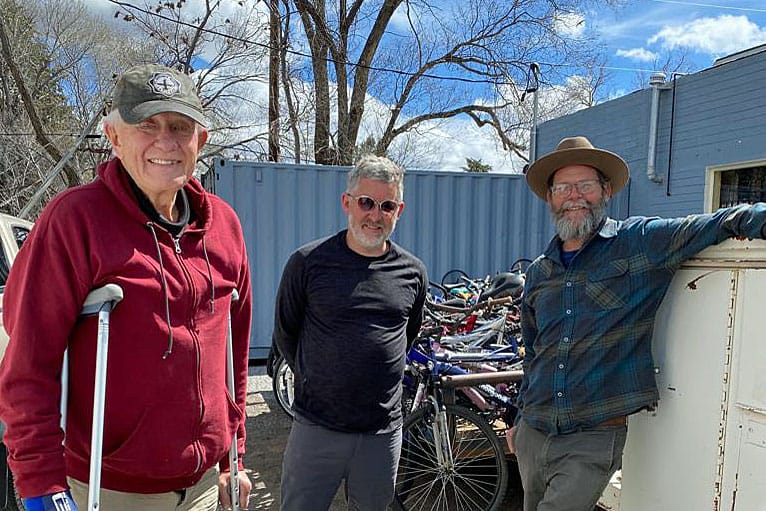
Peter Edmunds (left) and Dan Edmunds accepted a donation of used bicycles this month from The Bikeworks of Silver City, NM. The bicycles will enhance opportunities for exercise and improved health in Palomas.

On March 15, Border Partners founder Peter Edmunds was interviewed by Luke Moravec of Duluth, Minnesota’s 103.3 FM station about Border Partners’ sustainable technology mission. The interview is available on the station’s website. It’s transcribed below.

What did Minnesota want to know about what we’re doing in Palomas? Read on and see…

The Interview Transcription

Luke Moravec: It’s time now for Green Visions. Green Visions is a production of The North (103.3) to encourage green thinking and green actions. Green Visions is made possible by the Minnesota Power and Energy Conservation Program, making progress toward a lower carbon energy future.

And my guest today is Peter Edmunds working with Border Partners. Good morning, Peter!

Peter Edmunds: Good morning, Luke.

Luke: I asked you this earlier, but I want to hear this on the air: How are things in New Mexico right now?

Peter: Well, it’s going to be a bright sunny day, and I’m headed down to Mexico. We do a lot of donations of materials down here. I have 3,000 pounds of beans on a truck and trailer. With the pandemic and bad times in Palomas, there’s a lot of hungry people. So, that load will feed 30,000 servings of beans.

Luke: Wow…wow, well, you’ve got your checklist for the day, it sounds like. Thanks again for joining us on Green Visions. I just wanted to start out by noting that you are from the northland, but you have spent quite a bit of time in New Mexico. Get us up to speed a little bit with your work with Border Partners. How long has this been a part of your life and your routine?

Peter: My wife and I founded Border Partners in 2008. So, it’s coming up on 15 years old. We had retired several years before that and were looking for a long term volunteer activity. This sort of fell into place. It’s a nonprofit that does a lot of health, education, exercise, activity sorts of things. And then I–along with a lifelong interest in solar energy and alternative building methods–here I am. We’re no longer in the management of Border Partners, either Polly or me. But we both have projects that we are vitally interested in and actively managing.

Luke: Yeah, still driving trucks to locations where food is needed. So you still got some physical things to be doing around there. I want to talk a little bit about the communities where you’re working. What drew you to the locations specifically? I know that there are some specific needs that we’ll get into. But if you could, paint a picture for us: let us know a little bit about the communities where you are helping out.

Peter: Palomas is right on the border. The border wall goes right on the north edge of town all the way through, and it’s about 60 miles west of El Paso, Texas–that would be a big landmark down there. It’s a typically poor Mexican community. Like any country, communities on the edges of the country don’t get a lot of services from the government. So, it’s a kind of a neglected town with about four to five thousand people.

It’s in an agricultural area so there’s a lot of vegetables and cotton and beans and alfalfa grown. Most of the labor in this town is agricultural-related. So these men and some women make about $15-20 a day, working in the New Mexico sun. In the best of times–in the high season–they’re making $100/week or a little more. Food is really not much different in cost in Mexico, than regular supermarket food in the States.

Luke: Sure, sure. Go ahead.

Clean Groundwater

Peter: But there are problems that we deal with. In many arid regions of the world clean water is a major problem. And it is in Palomas. The groundwater here has arsenic, fluoride and nitrates in it–all naturally occurring. But it makes the water deadly to drink. You just shouldn’t. You can bathe with it, but you will not drink the water. So the town provides a reverse osmosis filter system. There are two locations where a family can get five gallons of water. But, one: they cost money and–two: they weigh something. A five gallon jug of water weighs 40 pounds. There are a lot of people who have trouble lifting 40 pounds…and carrying it: if they don’t have a car–they’re literally carrying it. I saw a senior citizen one day–a little tiny woman who couldn’t have weighed 100 pounds–and she’s carrying a 5 gallon jug of water down a long street going away from the water filter. I don’t know where she lived, but she would stop every block or so and set the jug down, walk around and flex her shoulders and then she’d go at it again.

Luke: If you’re just joining us, this is Peter Edmunds of Border Partners as part of Green Visions, who’s working in Mexico where people are carrying 40 pound water jugs to their homes from the town water filtration system. In what part were you a helpful component of that?

Peter: We did not directly help the town acquire their filtration system but we have developed other less expensive systems. We worked with a student at New Mexico State University about ten years ago. He was getting a degree in chemistry. One of his professors suggested to him that there was a way to make filters to take out arsenic and fluoride. He built a filter with just common pvc water pipe that will take out arsenic and fluoride and nitrates. We have put this filter in all the schools, kindergartens, and several churches in town so that the parishioners there can get good water and not have to carry it, maybe quite as far and not have to pay 25 cents a jug for it.

Luke: Kind of a grassroots effort then…?

Peter: And now we’re developing a “tech-sharing” page on our website, and the water filter will be part of that. So, if someone else around the world has a water problem that our filter is made for, they can look at the blueprints and look at the text. There’ll even be a video of some high school students making the filters. That’s a significant addition to the town.

Solar Energy

Luke: It would seem to be. So water filtration is one of the things that you’re doing. And you mentioned the hot New Mexico sun. All the same there’s also a need for solar heaters. Can you dive into that, too?

Peter: We have a solar heater that we developed some years ago. If you take my fancy little electronic temperature gauge and point it at a metal roof on a sunny day you can get up to 160 degrees temperature. So what we did was we took two sheets of metal roofing and spaced them about a 1/16 of an inch apart. We developed a little manifold of tubes.
Water from the reservoir is pumped up to the top of these two sheets of metal roofing and it flows down between them and gets amazingly hot.

It saves the family. They’ll have a 30-40 gallon tank of hot water every sunny day of the year and 90% of the days here are at least partially sunny. They are very rarely full cloudy days like there can be in Duluth, Minnesota. Those are a welcome addition to any family. They don’t have to buy propane to heat their own hot water. So it’s a major savings for them especially if you’ve got a family of little kids that need a bath every day or two. Or when they become teenagers they want a bath every day according to one of my friends who has three teenagers. So he’s very happy he’s got his water heater. And, again, that will go on the “tech share” part of our website. So if you want a solar heater any place in the world you can just look at that website.

We’re trying to reach beyond Palomas with our ideas. There’s so much need today because of climate change. So anything we can do to help avoid burning fossil fuels is a significant addition.

The kids that I work with are doing things…we’re just starting a project where we’re going to take newspaper, cardboard and grind it up and put it in a hold with some cement and make a building block out of that. It’s called papercrete. I’ve worked with that for more than 20 years. My house I’m sitting in right now has an addition on it that’s built of papercrete.

The nice thing about papercrete down here is that the town here has an old fashioned dump. I grew up in Western Minnesota. When you went to the dump you threw it in a hole in the ground and every once in a while, when the hole got filled, you just threw a match in it and burned everything. That is what this town has. In the US you can’t burn at dumps anymore.

Paper and clothes and wood and everything that people throw away–that’s the same toxic cloud that the US military is having problems with with half a million men–former soldiers– who come home with respiratory problems. That’s what the army does with the trash where these guys are defending the United States in Afghanistan and Iraq.

Luke: And Peter, with the time we have left I just want to get the information out there–to make sure that people know where to go to get the information. Where is the website?

Peter: The website is borderrpartners.org –all small letters. We’re happy to hear from you.

Luke: Absolutely. Peter, thank you for taking the time today. And good luck with your ventures today in Mexico.

Peter: Thank you very much for having me. I appreciate it.

Luke: Be well, Peter. That was Peter Edmunds on Green Visions. Green Visions is an action of The North. Green Visions is made possible by the Minnesota Power and Energy Conservation Program, making progress toward a lower carbon energy future.

Intern boosts Border Partners’ Effectiveness in Palomas

Hi Everyone! My name is Lily Eichorst, and I am Border Partners’ new intern in Palomas. I want to tell you all a little bit about me, why I am here, and what I am doing:

Background

I am originally from a little town in northern Wisconsin, but for the last few years I have been studying International Relations at Karlshochschule International University in Karlsruhe, Germany. Prior to commencing my undergraduate studies, I spent a semester enrolled in an international studies program at the International People’s College in Denmark and the following several months volunteering with an NGO from the refugee aid sector in Serbia. Most recently, I was fortunate enough to spend a semester in Argentina immersed in Spanish, studying Latin American economics and environmental sociology. I am passionate about humanitarianism, community building, and facilitating intercultural exchange and dialogue.

Focus and Intent

Lily Eichorst

Lily Eichorst

Addressing border-specific issues that arise in these particularly unique contexts around the world has been a key focus of my academic and professional life so far. I have a keen interest in forced migration and international refugee law, and hope to center on these interest areas as I write my Bachelor thesis and begin graduate studies next year.

I will be with Border Partners for the next few months completing my internship. After just a couple of weeks here I can say there is nowhere else I’d rather be! The opportunity to engage with an array of diverse projects on the ground, to connect with the passionate members of the community in Palomas, and to help with whatever I can is such a privilege.

So, you’ll be hearing more from me as I take on some of Border Partners’ social media pages, participate in daily affairs and projects, and improve my Spanish-English translation skills!

Profiles of the People Who Lead Our Programming

The heart of any organization is the people that commit to serving its broader mission. Here at Border Partners, we are proud to count passionate and dedicated people among our staff. In recognition of all their hard work, we would like to highlight each of them and give an overview of what they do day-to-day to realize our diverse array of projects in Palomas. This month, we will feature profiles on four of our staff members, with the rest following next month. So, let’s get to know our crew!

Juan Rascon, Border Partners General Manager

Juan Rascon, General Manager / Gerente general

Serving with Border Partners since 2013 and celebrating his 10-year work anniversary this year, Juan Rascon has undertaken an array of roles throughout that period. He began working in construction of sustainable papercrete blocks. Then, he oversaw the opening of the Education Center, supervising daily operations and offering basic English classes.

As time went on, he took on more responsibility as a primary language translator. Eventually Juan coordinated the many projects in Palomas and worked in administration and operation of finances. Last year, after a period as Assistant General Manager, Juan assumed the role of General Manager of Border Partners.

When asked what he most enjoys about the work through his many years with Border Partners, Juan responded: “I think the success of our work is because we have so many different projects that meet a wide range of needs in the community. I am most passionate about seeing the gratitude of those who participate in our programs.”

Aside from his responsibilities as General Manager, Juan lives in Palomas with his wife Carina and two children Jose Luis and Juan. His family has a soft spot for animals and have rescued several dogs and cats over the years. He describes himself as “an aficionado of everything to do with mechanics and cars.” He likes to spend his free time riding his motorcycle and spending quality time with family.

Victoria Ibarra, Coordinator of the Promotoras

Viky Ibarra, Coordinator of the Promotoras

Born in Oaxaca, Mexico, Victoria “Viky” Ibarra arrived in Palomas 12 years ago and has been with Border Partners for 11 of those years. She works as the coordinator of the health promoters, or ‘las promotoras,’ who work daily in Palomas to improve the health of people in the community. As coordinator, she tracks expenses, makes the schedule, files monthly reports, and visits local schools to promote public health awareness and healthy eating.

Viky stressed the importance of the healthy and friendly work environment at Border Partners when asked about job satisfaction. She jests: “Aqui nos queremos; no nos gritamos!” (“Here we love one another; we don’t shout at each other!”) She finds meaning in the work through contact with her community and in the opportunity to help and serve them. Besides working for Border Partners, she also acts as secretary for the volunteer fire department in Palomas, where her husband is a firefighter.

Viky lives full time in Palomas with her husband,  her older daughter and her almost-2-year-old baby, Emmanuel. In her free time, she enjoys spending time with her family and visiting her many nieces and nephews.

Arcelia Amaya: Promotora and Head of Cleaning

Arcelia Amaya Rivas, Health Promoter
/ Promotora de Salud

Arcelia Amaya is a recent addition to Border Partners, joining the team in January 2023 as a health promoter. She works as cleaning coordinator for the promotoras to maintain cleanliness in the workplace. In addition, she is a certified Zumba instructor and offers classes to women in the community each morning from Monday to Friday at Border Partners’ headquarters.

Of the short time she’s worked here, Arcelia says: “I enjoy how we work as a team. I get along well with my colleagues. And, all the knowledge I’ve gained is very useful.”

She lists workplace harmony, the connection with older people in the community, and the services Border Partners provides as the aspects of her job she enjoys most.

Arcelia lives in Palomas with her 10-year old daughter Ingrid and operates a water purifying business alongside her job with Border Partners. She is a successful local entrepreneur and aspires to have a prosperous business that can help many people. In her free time, she enjoys giving services at her local church, spending time with her daughter, and staying active.

Joel Carreon Minjares, Director of Gardening, a.k.a. “Profe”

Not only has Joel “Profe” (short for “Professor”) Carreon Minjares been working with Border Partners for over two years as the director of the community gardening project. He’s also the director of the local university preparatory school in Palomas, where he has worked for 28 years. Native to Palomas, generations of his family hail from there, and he has served his community in many capacities over the years.

Joel Carreón, Botanist-Garden Specialist and Coordinator, Coordinador y Especialista en Jardineria

With Border Partners, Joel is passionate about all projects related to sustainability. Right now, he’s working on a collaboration with local students to promote and experiment with sustainable building materials. Further, he’s working to acquire water filtration devices that can help stem the issue of contaminated water common in the region near Palomas. He sees finding new ways to adapt to climate change as a dynamic process. He’s experimenting currently with a process to plant trees in Palomas that will require less water. This is because the issue of overconsumption of water in the agricultural sector is a grave environmental danger. His overarching aim in all this, he says, is to “prepare the next generation of students for the future of environmental and climate change.”

Aside from working with Border Partners, Joel teaches physics and ecology in addition to his responsibilities as director at the high school in Palomas. He is passionate about preparing students for university. In his free time Joel runs a group that provides extra help to students interested in attending university.

Joel was educated himself as an animal agriculture technician. He has three grown children and lives in Palomas with his wife. Above all, he emphasizes, he is most passionate about “developing projects to improve and protect the environment.”


Each staff member of Border Partners forms an integral part of our operations on the ground in Palomas and in ensuring the long-term success of our projects. We are so grateful for the work that they do and the passion they bring to their community!

What a Candy Bar Sale Reveals about Life in Palomas

In a bountiful world, some children may not find their desires easy to attain. (File illustration)

When Juan Rascon, Border Partner’s General Manager, encountered a 5-year-old boy selling candy bars in a downtown Palomas street, he agreed to purchase one. Then, he began a conversation with the lad. They exchanged names, and Juan discovered that he knew the child’s father.

“Why are you selling candy bars?” Juan inquired.

“Because I want to buy an electronic tablet,” responded the boy, “and I’m making money to buy it.”

“Tell your dad that you have a new friend named Juan Rascon. He knows me,” replied Juan as he left.

Juan returned home and consulted a few people. Among them, they found a new electronic tablet that no one was using. They charged the tablet, so it was ready to use.

Then Juan went to that family’s home and asked the father if the boy was there.

The Surprise Revealed

“Do you remember me?” Juan asked the 5 year-old.

“Yes, you’re my friend Juan.”

The two shook hands, and Juan continued: “I have a deal for you. Would you like to trade me a candy bar for a box I have for you?”

The boy looked at his dad, who commented: “Sounds like a good deal for you!”

But, turning back to Juan, he admitted, “But I’ve run out of candy bars.”

“That’s no problem,” replied Juan. “Whenever you have more, you can give me my candy bar.”

Then, Juan reached into his car, grabbed the box and presented it to the lad.

“Open it in front of your dad,” Juan suggested.

The boy’s eyes widened as he opened the box. “It’s a tablet!” he exclaimed. He teared up and hugged Juan.

The dad said, “Thank you. He’s been saving for his tablet.”

And Juan responded, “Now he can save for something else that he’d like.”

Questions without answers

When Juan was small, and growing up in Palomas, he also worked to buy things because his family was poor.

“It’s good to learn to work to buy what you need,” he told the child.

A productive life is better than an aimless one, he reasons.

As Juan reflected on this incident, we can gain some insight into Palomas life.

A 5-year-old is too little to be working. But, here in Mexico, we see that all the time. I’d rather see them selling something than doing something unproductive. If kids grow up with time on their hands and not doing anything-–that’s when they get in trouble. But his dad is teaching him how to work, so that’s good.”

“And now,” concluded Juan, “I have a new little friend.”

And, perhaps in the retelling of this story, US citizen-partners of Border Partners have gained a bit of insight into the social situation in Palomas.